PURPOSE & IMPACT

Category: Organization (page 1 of 5)

Psychological Safety in Organizational AI Transformations

A recent IMD business school article highlights the importance of psychological safety in organizational AI transformation, based on related experiences, from Kameshwari Rao, Global Chief People Officer at international digital consulting firm Publicis Sapient. This also provides useful notes for leaders who are thinking about or working through AI related transformations.

These are selected notes from the article.

* Organizations need a psychologically safe environment for their employees to innovate and experiment.
* Unless employees feel psychologically safe, it is unrealistic to expect them to engage with, let alone embrace, the technology. Inevitably, user hesitation will impede organizational efforts to explore AI.
* Important to remember that “People’s identities are at stake”.
* Human intelligence has been evolving for hundreds of thousands of years, developing characteristics such as empathy, resilience, and judgment to adapt to a changing environment. The role of leaders is to remind people that they possess those irreplaceable human qualities.
* Requires businesses to commit to increased communication and support that considers each employee’s personal reaction to the technology and allows them to adapt at their own pace.

* Publicis Sapient focused on three simultaneous strands of AI change:
1. the shift to a mindset of curiosity rather than anxiety about AI,
2. building confidence, and
3. integrating AI tools into everyday jobs.

* “We wanted to begin the conversation by getting everybody to have a bit of fun with AI. It was about building familiarity.”
* The town hall was followed with a dedicated campaign, AI Habits, where the goal was to pique curiosity, with initiatives based on psychological research into habit formation.
* At the same time, Publicis Sapient prioritized experimentation, getting people to think about the skills and training they might need to make the most of AI. One useful approach here was gamification. 
* Note that companies should not see these three AI initiatives as one-and-done exercises: “At any given point, you will have people at different stages in all three areas – everyone’s change cycle is different.
* Leaders have framed AI as an ongoing learning journey.
* Listening, sharing – a range of listening tools that Publicis Sapient uses to understand whether employees are feeling confident in the workplace. Leaders, starting with the CEO, also serve as role models, share their own anxieties.
* No single initiative will create psychological safety around AI. Rather, it will take a spread of different, ongoing measures. 

Source: Publicis Sapient on AI: A three-step guide to psychological safety; IMD; June 8, 2026
Notes on Organisational Political Dynamics and the Concept of Dominant Coalition

I noticed some interesting, practical notes regarding ‘organisational political dynamics’, from the new book, The Age of HR. Since this was relatable from past experiences and valuable to reflect on, I thought of sharing. Have you been able to observe dominant coalitions in your organisations?


These notes are from Chapter 59 – To Be or Not to Be Part of the Dominant Coalition as the CHRO: Understanding the Political Dynamics of Your Organisation and How to Deal with Them, written by Dirk Buyens, Koen Dewettinck, and Silke Van Gansbeke


* It is helpful to recognise that politics and political behaviour are an inherent part of organisational life.
* In Darwinian terms, ‘survival of the fittest’ in this context often means those who are able to adapt best to the political environment are often the winners. 
* In executive committees, we once again observe striking differences in who truly has influence and who does not.

* The dominant coalition can be defined as the group of individuals who, relative to their peers, exert a disproportionate level of influence over organisational decisions. Every company contains employees who, over time, gravitate towards the centre of decision-making in the organisation.
* In practice, dominant coalitions are rarely secretive. Most employees are aware of who belongs to them, and very often it is functionally driven.

* For a CHRO, it is crucial to understand what we refer to as the paradox of the right strategy. The ‘right’ strategy is typically one chosen that delivers quick wins soon. Even if an alternative strategy might have produced superior long-term outcomes, this can never be proven. Challenging the dominant coalition on this basis is therefore futile and politically suicidal.

* The fundamental question CHROs must ask is: “How important is it for me to be part of the dominant coalition, and what price am I willing to pay?”
* Being part of the dominant coalition as a CHRO ensures that HR processes and policies are taken seriously when key decisions are made. The downside is that HR may be perceived as less neutral, undermining the role of the credible activist.
* Remaining outside the dominant coalition enhances perceived neutrality but risks HR initiatives being dismissed as mere exercises that aren’t taken seriously when it truly matters. 
* Ultimately, successfully sensing and navigating dominant coalitions requires strong political skills from the CHRO. 
* There must be a balance between the degree to which an organisation tolerates political behaviour and one’s own personal tolerance for it.
* Some CHROs are dismissed for being too naïve; others for being overly political. In all cases, dominant coalitions – and how CHROs engage with them – profoundly shape their careers. Purposeful self-management is therefore indispensable.
* Until CHROs navigate the political nature of organisations, they will continue to be limited in their impact. 

Understanding Country Culture Link to General Behaviours and Approaches

Understanding the different dimensions of country cultures could often help clarify behaviours, ways of working, approaches and interactions better. That of course would not answer everything. There are always personality elements, professionalism/maturity levels, individual styles and sub cultures at play, in interactions.

A couple of recent related news items got me thinking about this topic. A journalist from Norway asked a question, which a diplomat from India answered, and both parties did not seem engaged or happy with their style or approaches in interactions. These sort of frustrations in interactions can be seen in the global workplace often. I think that at least a good portion of the frustration stems from the difference in their cultural contexts.

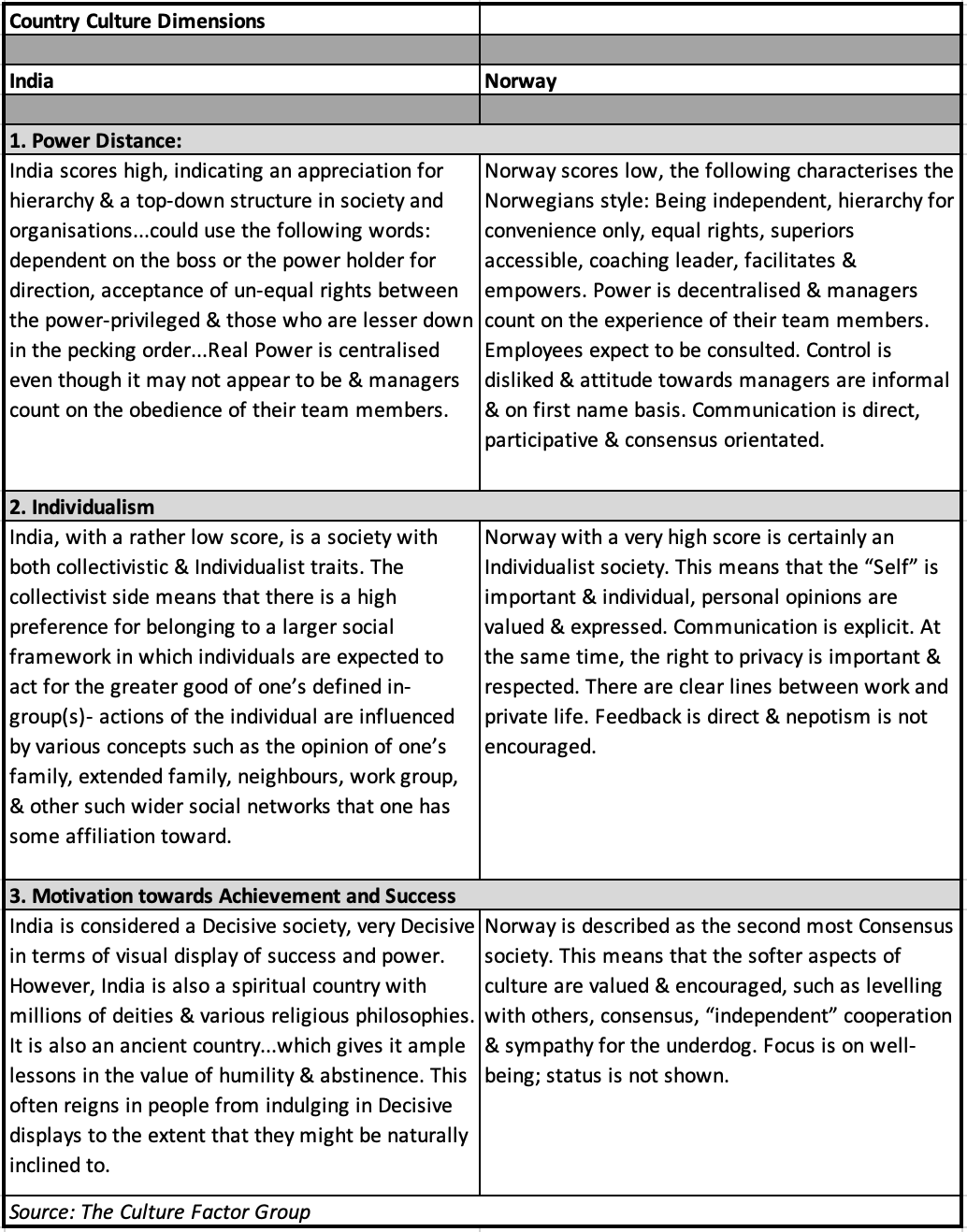
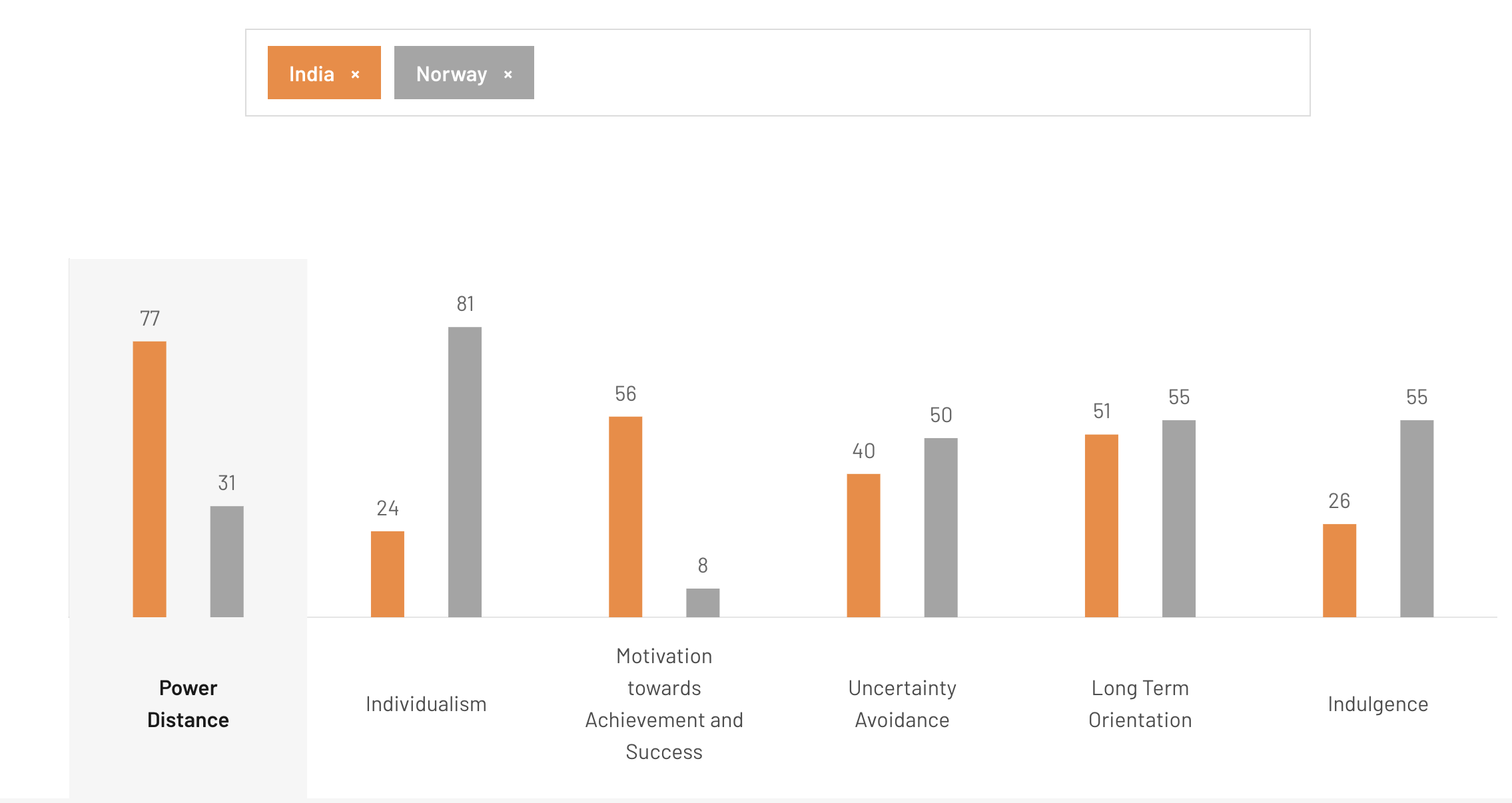
I gathered the following, selected notes from the The Culture Factor Group, Culture Dimensions Country Comparison tool – which compares India and Norway. Having lived and worked in Scandinavia for many years, I can see why it would be easy to misunderstand or ‘not get’ someone on the either side. The Culture Dimensions structure inputs originated from the late Prof. Geert Hofstede’s research. He was one of the most well-known experts in comparative intercultural research. These cross cultural inputs are updated through research notes periodically by the Culture Factor group.

According to inputs from the tool, major culture dimension differences exist between India and Norway in three out of the six dimensions – Power Distance, Individualism and Motivation towards Achievement and Success. Selected notes on these dimensions are included below. Hope this will help in thinking about the topic more deeper.


Notes On Workforce Analytics for Strategy Execution

This is a continuation of valuable notes from the free book, The Age of HR.

This post covers Chapter 14, Workforce Analytics for Strategy Execution: Ten Years Later (2015–2025) by workforce analytics guru, Mark Huselid. He co-authored the well known Harvard Business Review article, titled “A Players” or “A Positions?: The Strategic Logic of Workforce Management”.
There’s lots of valuable guidance and wisdom here, especially for those who have followed the topic of workforce analytics by Prof. Huselid over the years.

Image generated with Chatgpt

* 3 linked moves for leaders (HR & Line managers) who want to improve strategy execution through the workforce:
(1) identify the strategic work necessary to execute strategy;
(2) build differentiated workforce systems that enable that work;
(3) design measurement systems that connect workforce investments to business outcomes and reinforce accountability.
* ..the last decade has clarified a critical distinction: adopting analytics tools is comparatively easy; building an enterprise capability that reliably improves decisions is not.

* Not all jobs are equally strategic. “A” positions matter for strategy execution and exhibit high variability in individual performance, offering the greatest upside from improvement.
* Great firms manage their workforce like a portfolio, investing disproportionately in the highest return strategic work.

* This portfolio logic requires explicit tradeoffs.
* The practical test: Can senior leaders name the five to ten roles that matter most for executing the current strategy, and explain why those roles warrant disproportionate investment?

* Data abundance creates a false sense of progress.
* Enforce a simple rule-no measurement without a prior decision context.
If a metric does not help a specific decision-maker choose between competing alternatives, it should not be produced, regardless of how easy it is to generate.

* Correlation is abundant, causation is rare, and the difference determines whether workforce investments deliver returns or waste resources. Organizations that lack a causal model cannot learn from experience because they cannot distinguish signal from noise.

* In global settings, the strategic importance of jobs may differ by region.
“A positions” should not be treated as a single universal list; rather, the organization needs a consistent logic for identifying them, applied with contextual specificity.
* Identify strategic roles based on their contribution to strategy execution and performance variance, not tradition or hierarchy.

* Strategic jobs that matter today may not be the same five years from now.

* What works in one cultural context may not work in another.

* Advanced analytics raises concerns about privacy, fairness, and transparency. Embed responsible data management, informed consent, and bias checks into every step, treating ethics as integral to trust and long-term viability.

Progress of Women In Corporate Roles

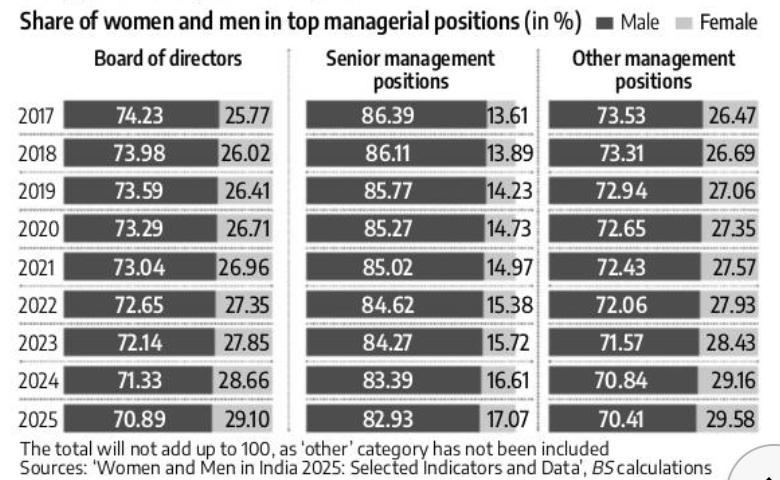
Data shared in this week’s Business Standard paper, based on the “Women and Men In India 2025 Report” indicates that there is a lot of continued work needed in this area. The data indicates basic incremental progress.

Some key notes:
* Even as women are making inroads into corporate leadership roles, gains remain limited. The change is gradual. Pay gaps continue to persist.
* Women representation in corporate boards inched up from 25.8% in 2017 to 29.1% in 2025 (similar incremental rises across other management roles). However, their share in senior management remains sharply skewed at just over 17%.
* Women’s labour force participation has risen from 23.4% in 2018 to 40% in 2025 but remains far below men at nearly 80%.


Source: Business Standard, May 7, 2026, Datanomics, Women See Limited Gains in Top Jobs, Shikha Chaturvedi.

Does Kindness Have A Place in Business?

Noticed refreshingly different perspectives from Mayank Rautela, Group CHRO at Apollo Hospitals – regarding how kindness is not just a “soft skill” but a business imperative and how it can be strategically embedded into leadership. There are some valuable notes for reflection, especially for healthcare leaders everywhere and the interview (referenced below) is worth reading.

Selected notes from the interview with ETHRWorld:
* Genuine human connection is profoundly contagious. It transforms a transactional environment into a compassionate one, inspiring others to pay it forward and shaping a culture where compassion is the norm, not the exception.
* Kindness is a strategic driver of performance. It’s the foundation of psychological safety…We’ve consistently observed that teams that practice kindness most also have the highest engagement, lowest attrition and better clinical outcomes. Research validates this link: empathy in care leads to greater patient loyalty and trust.
* For a leader, kindness is a core competency, not a soft trait. It’s about leading with authentic empathy and vulnerability.
* We are conditioned to prioritise efficiency over empathy, and many feel they simply don’t have the time to be kind. The real issue isn’t a lack of desire, but fear that kindness may be seen as weakness.
* Kindness must be an institutional commitment, not an accident…also lives in the way we celebrate our people.
* We balance performance with empathy by making kindness integral to our HR strategy.
* Kindness endures when it is deeply woven into the fabric of an organisation’s DNA – through its values, everyday behaviors, recognition systems, and leadership practices…cannot be a one time initiative, must be a way of life.

Source:
Kindness isn’t soft — it is strategy: Apollo Hospitals’ Mayank Rautela on reshaping workplace culture; ETHRWorld; October 1, 2025.

Leadership Insight from Neuroscience studies on Building Accountability

There are some valuable notes from neuroscience research for leaders on how to improve responsibility and accountability in their organizations. The article is ‘Latest From the Lab: Ownership drives responsibility’ from the NeuroLeadership Institute, published on July 28, 2025

(Image- Gerd Altmann, Pixabay)
—-
” While 91% of managers and employees say accountability is important at work, 97% of managers say they struggle to hold their teams accountable.say they struggle to hold their teams accountable.

* A recent study suggests that our sense of responsibility, and the brain activity that supports it, can emerge from having a sense of control or agency in our work, as opposed to merely following orders.
* In a newly published brain imaging study, researchers showed that the act of merely following someone else’s orders, or not having ownership of our decisions, reduces our sense of responsibility for the actions that follow. In other words, how responsible we feel, stems from having a “stake in the game,” or some degree of ownership in the work.
* This study builds on a growing body of work into how accountability happens in the workplace. Taking responsibility for the work done and the impact made is one of the characteristics of accountability, a concept that…is a current challenge facing many.
* Prior research has shown that when we lose our sense of control, such as when we’re obeying orders or being told to do something, this immediately reduces our perception of responsibility. We feel less responsible for an outcome if someone else, especially with a higher status or rank, told us to do it. This poses a major challenge to organizations…
* Behaviors that managers could engage in to drive their team towards accountability:
– reminding a team member during a weekly check-in of the reason their work is critical, whether/how it’s aligned with an organizational goal or a team goal (will increase engagement of the networks in the brain associated with the “why” behind the work).
– managers can help employees feel a greater sense of ownership over their work by making the work meaningful to the individual or align it with their career goal. (will act to increase the person’s sense of agency, and ultimately, responsibility for the work.)”

Shrinking (Middle) Management?

From a recent CNBC article (listed below):

“A Google executive told employees last week that in the past year, the company has gotten rid of a third of its managers overseeing small teams.

…said the idea is to reduce bureaucracy and run the company more efficiently.

The 35% reduction refers to the number of managers who oversee fewer than three people, according to a person familiar with the matter. Many of those managers stayed with the company as individual contributors, said the person, who asked not to be named because the details are private.

CNBC previously reported that the layoffs hurt morale as the company was downsizing while at the same time issuing blowout earnings and seeing its stock price jump. Alphabet’s shares are up 10% this year after climbing 36% in 2024 and 58% the year prior…”

Few questions that come to my mind:
Is this a part of a broader trend of restructuring, where companies across the board are actively trying to reduce management layers? More and more companies seem to be announcing reduction of managers and layers.
How do organizations get here in the first place? As they grow, do uncontrolled inefficiencies naturally creep in?
How does this impact feelings of loyalty and commitment (internal), among employees who still remain employed with the organization?
How does AI progress influence these changes and decisions?

If the nature of work or the environment hasn’t really changed, then such cuts may not really help the companies in the longer run (other than improving short term costs). Well designed and planned manager roles are normally intended to help efficiently deliver outcomes and the cuts without proper planning and foresight lead to confusion, inefficiencies and frustration over time.

Organizations and leaders have to think deeply about their optimal organization design and structure, without needing to revisit the same topic frequently. Otherwise, constant organization disruptions consume a lot of attention and energy from members which inevitably end up taking focus away from the core topics – differentiated business impact, customers, stakeholders, the marketplace.

There seems to be at least two clear perspectives in these shifts – companies working on becoming more efficient on one side
(with constant investor pressure) and, employees figuring out how to survive and thrive during times of such major changes.

Source: Google has eliminated 35% of managers overseeing small teams in past year, exec says; CNBC; August 27, 2025; Jennifer Elias

Useful Research References – Leadership Practices & Talent Retention Link

Sharing valuable notes for leaders on talent retention, from a recent RBL Group newsletter, with helpful research references…

* Data shows that 97.4% of employees cite personal interaction with leaders as crucial to their decision to stay (De Araújo Oliveira & Hansch, 2024).
* Leadership capability gaps create retention crises that no amount of compensation can solve. When leaders lack the skills to connect, develop, and inspire their teams, even well-compensated employees leave.
* Your customers experience your leadership capability through every interaction with your employees. Disengaged teams deliver mediocre customer experiences. High turnover disrupts service continuity. Leadership failures cascade into stakeholder value destruction.
* Research across multiple sectors shows that organizations with structured leadership approaches consistently outperform those relying on ad-hoc interventions.
* From the oil contracting sector during economic crisis – companies that maintained strong leadership communication and personal interaction retained critical talent while competitors hemorrhaged expertise (García-Rincón & Parra-Machado, 2022).
* IT organizations discovered that transformational leadership created stronger retention impact than individualized financial benefits (Berettera et al., 2023)
* Healthcare organizations implementing inclusive leadership practices report these as “key for retention” (Martínez-González et al., 2023)
* Organizations that build leadership as an enterprise capability-not just individual skills-create sustainable competitive advantage through their talent.

Source: The Leadership Factor: Why 97.4% of Retention Hinges on Personal Connection; RBL Impact; August 20, 2025.

Effects of Incivility on your business and people

What are the effects of incivility (disrespect/rudeness) on your business and people?

A TED Talk (video link below) from Prof. Christine Porath includes useful references on this topic, which are backed by research. There are also some positive behavioural examples (if you are wondering, as a manager or leader, how you could do better on this dimension).

Selected notes from the talk:
* Small, uncivil actions can lead to much bigger problems like aggression and violence.
* According to their study, incivility made people less motivated. 66% cut back work efforts, 80% lost time worrying about what happened, 12% left their job.
* For those who witness incivility, witnesses’ performance decreased, too…quite significantly.
* Incivility is a bug. It’s contagious, and we become carriers of it just by being around it. And this isn’t confined to the workplace.
* It affects our emotions, our motivation, our performance and how we treat others. It even affects our attention and can take some of our brainpower. And this happens not only if we experience incivility or we witness it. It can happen even if we just see or read rude words.
* This can be a big deal, especially when it comes to life-and-death situations. Researchers have actually shown that medical teams exposed to rudeness perform worse not only in all their diagnostics, but in all the procedures they did. This was mainly because the teams exposed to rudeness didn’t share information as readily, and they stopped seeking help from their teammates.
* The number one reason for incivility is stress. People feel overwhelmed. The other reason is because they’re skeptical and even concerned about being civil or appearing nice. They believe they’ll appear less leader-like. It’s easy to think so, especially when we see a few prominent examples that dominate the conversation.
* According to research from the Centre for Creative Leadership, number one reason tied to executive failure was an insensitive, abrasive or bullying style.
* It ties to one of the most important questions around leadership: What do people want most from their leaders? We took data from over 20,000 employees around the world, and found the answer was simple: respect. Those that felt respected were healthier, more focused, more likely to stay with their organization and far more engaged.
* Civility and respect can be used to boost an organization’s performance.
* When we have more civil environments, we’re more productive, creative, helpful, happy and healthy.

Older posts

© 2026 Lead-Wise

Theme by Anders NorenUp ↑