PURPOSE & IMPACT

Category: Leadership (page 1 of 6)

Notes on Organisational Political Dynamics and the Concept of Dominant Coalition

I noticed some interesting, practical notes regarding ‘organisational political dynamics’, from the new book, The Age of HR. Since this was relatable from past experiences and valuable to reflect on, I thought of sharing. Have you been able to observe dominant coalitions in your organisations?


These notes are from Chapter 59 – To Be or Not to Be Part of the Dominant Coalition as the CHRO: Understanding the Political Dynamics of Your Organisation and How to Deal with Them, written by Dirk Buyens, Koen Dewettinck, and Silke Van Gansbeke


* It is helpful to recognise that politics and political behaviour are an inherent part of organisational life.
* In Darwinian terms, ‘survival of the fittest’ in this context often means those who are able to adapt best to the political environment are often the winners. 
* In executive committees, we once again observe striking differences in who truly has influence and who does not.

* The dominant coalition can be defined as the group of individuals who, relative to their peers, exert a disproportionate level of influence over organisational decisions. Every company contains employees who, over time, gravitate towards the centre of decision-making in the organisation.
* In practice, dominant coalitions are rarely secretive. Most employees are aware of who belongs to them, and very often it is functionally driven.

* For a CHRO, it is crucial to understand what we refer to as the paradox of the right strategy. The ‘right’ strategy is typically one chosen that delivers quick wins soon. Even if an alternative strategy might have produced superior long-term outcomes, this can never be proven. Challenging the dominant coalition on this basis is therefore futile and politically suicidal.

* The fundamental question CHROs must ask is: “How important is it for me to be part of the dominant coalition, and what price am I willing to pay?”
* Being part of the dominant coalition as a CHRO ensures that HR processes and policies are taken seriously when key decisions are made. The downside is that HR may be perceived as less neutral, undermining the role of the credible activist.
* Remaining outside the dominant coalition enhances perceived neutrality but risks HR initiatives being dismissed as mere exercises that aren’t taken seriously when it truly matters. 
* Ultimately, successfully sensing and navigating dominant coalitions requires strong political skills from the CHRO. 
* There must be a balance between the degree to which an organisation tolerates political behaviour and one’s own personal tolerance for it.
* Some CHROs are dismissed for being too naïve; others for being overly political. In all cases, dominant coalitions – and how CHROs engage with them – profoundly shape their careers. Purposeful self-management is therefore indispensable.
* Until CHROs navigate the political nature of organisations, they will continue to be limited in their impact. 

Understanding Country Culture Link to General Behaviours and Approaches

Understanding the different dimensions of country cultures could often help clarify behaviours, ways of working, approaches and interactions better. That of course would not answer everything. There are always personality elements, professionalism/maturity levels, individual styles and sub cultures at play, in interactions.

A couple of recent related news items got me thinking about this topic. A journalist from Norway asked a question, which a diplomat from India answered, and both parties did not seem engaged or happy with their style or approaches in interactions. These sort of frustrations in interactions can be seen in the global workplace often. I think that at least a good portion of the frustration stems from the difference in their cultural contexts.

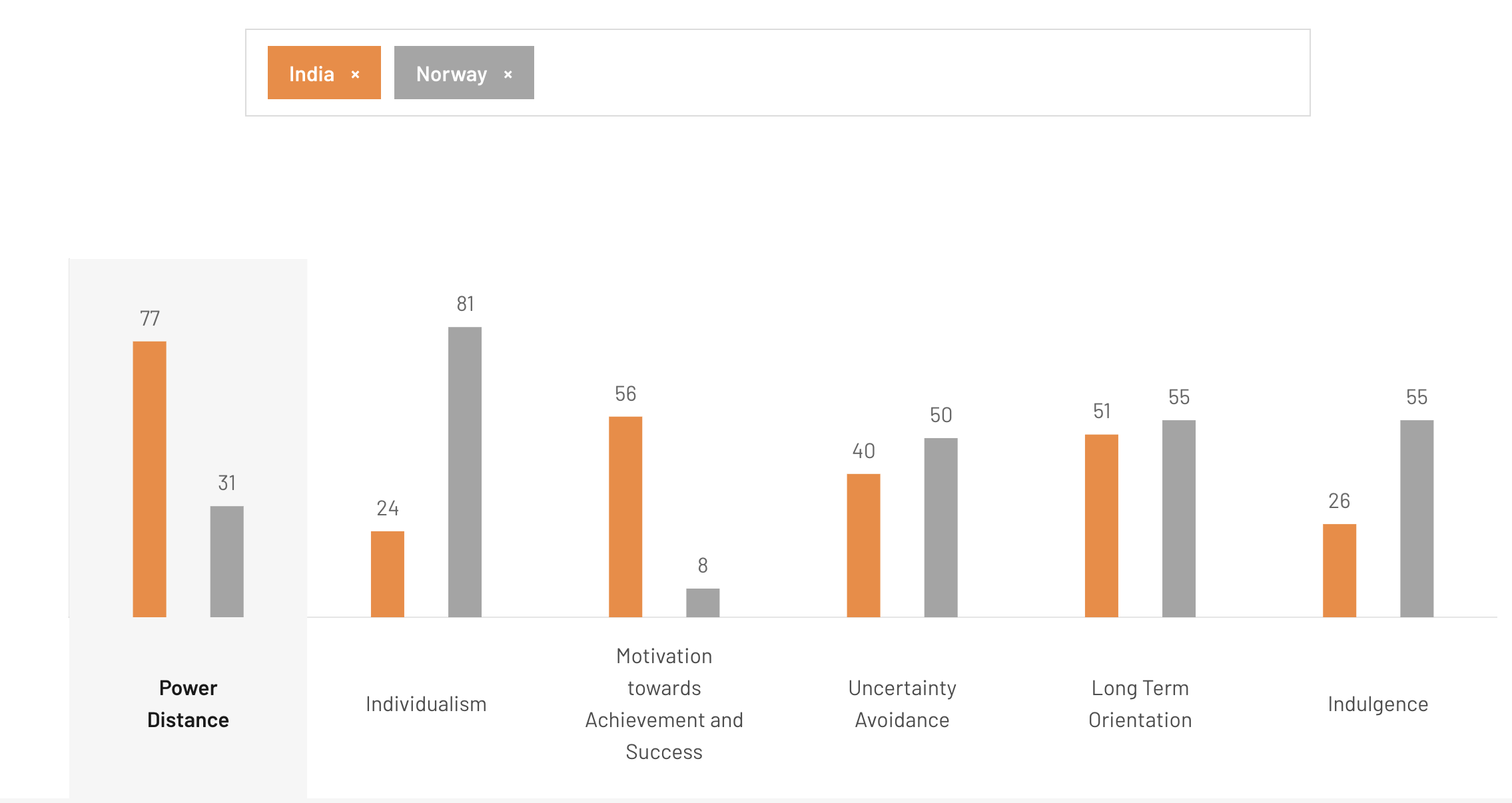
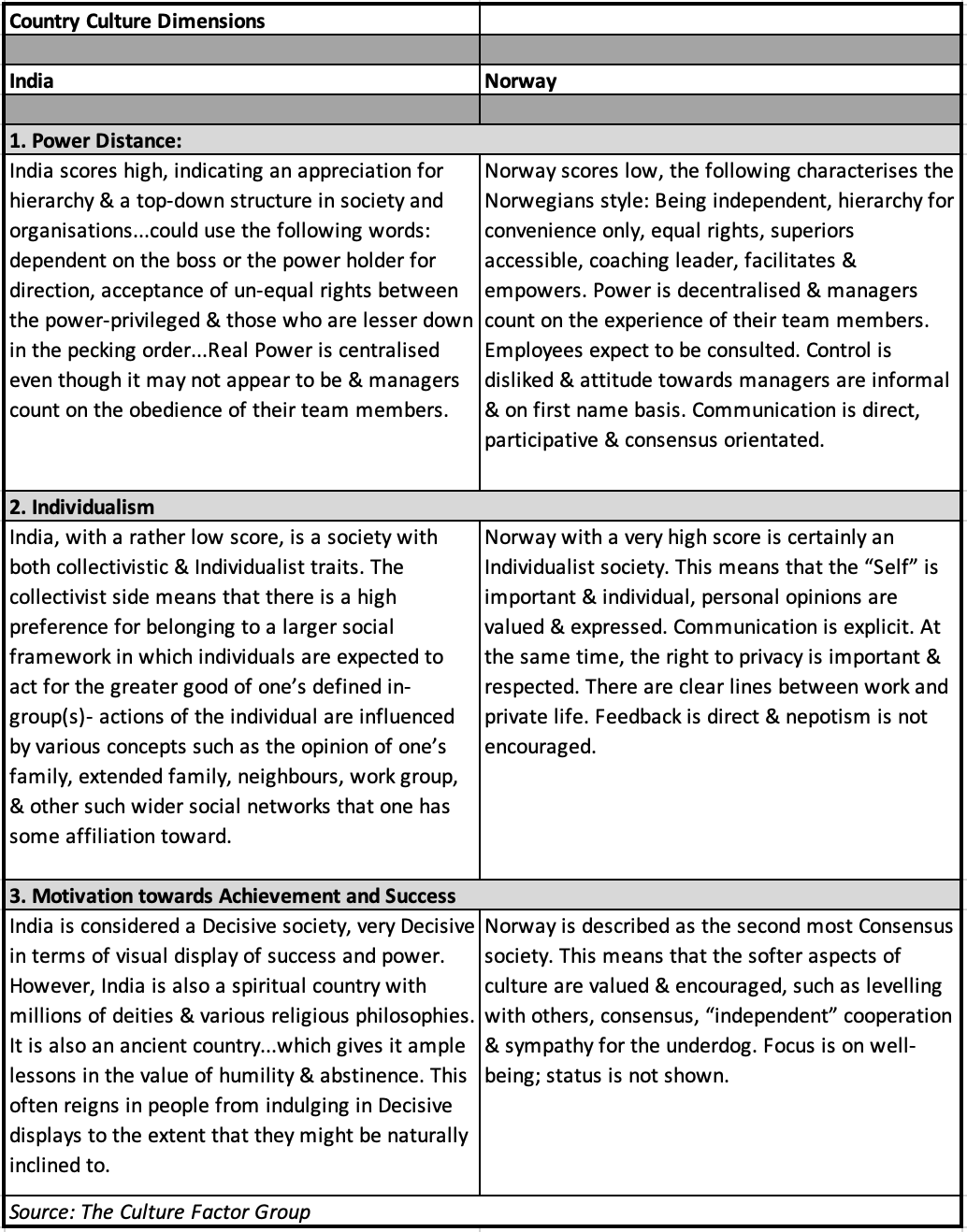
I gathered the following, selected notes from the The Culture Factor Group, Culture Dimensions Country Comparison tool – which compares India and Norway. Having lived and worked in Scandinavia for many years, I can see why it would be easy to misunderstand or ‘not get’ someone on the either side. The Culture Dimensions structure inputs originated from the late Prof. Geert Hofstede’s research. He was one of the most well-known experts in comparative intercultural research. These cross cultural inputs are updated through research notes periodically by the Culture Factor group.

According to inputs from the tool, major culture dimension differences exist between India and Norway in three out of the six dimensions – Power Distance, Individualism and Motivation towards Achievement and Success. Selected notes on these dimensions are included below. Hope this will help in thinking about the topic more deeper.


Powerful Notes /Reflection on Leadership

For unexplainable reasons, an article I had read around couple of decades back came to mind suddenly.

“Leader presumes follower. Follower presumes choice. One who is coerced to the purposes, objectives, or preferences of another is not a follower in any true sense of the word, but an object of manipulation. Nor is the relationship materially altered if both parties voluntarily accept the dominance of one by the other. A true leader cannot be bound to lead. A true follower cannot be bound to follow. The moment they are bound they are no longer leader or follower. If the behavior of either is compelled, whether by force, economic necessity, or contractual arrangement, the relationship is altered to one of superior/subordinate, manager/employee, master/servant, or owner/slave. All such relationships are materially different from leader/follower.

Induced behavior is the essence of leader/follower. Compelled behavior is the essence of all the other relational concepts. Where behavior is compelled, there you will find tyranny, however benign. Where behavior is induced, there you will find leadership, however powerful. Leadership does not necessarily imply constructive, ethical, open conduct. It is entirely possible to induce destructive, malign, devious behavior, and to do so by corrupt means. Therefore, a clear, constructive purpose and compelling ethical principles evoked from and shared by all participants should be the essence of every relationship in every institution.

A vital question is how to insure that those who lead are constructive, ethical, open, and honest. The answer is to follow those who behave in that manner. It comes down to both individual and collective sense of where and how people choose to be led. In a very real sense, followers lead by choosing where to be led. Where an organizational community will be led is inseparable from the shared values and beliefs of its members.

True leaders are those who epitomize the general sense of the community – who symbolize, legitimize and strengthen behavior in accordance with the sense of the community – who enable its shared purpose, values and beliefs to emerge and be transmitted. A true leader’s behavior is induced by the behavior of every individual choosing where to be led.”

Source: Hock, Dee “The Art of Chaordic Leadership” Leader to Leader. 15 (Winter 2000): 20-26.

Human Qualities Most Likely to Matter In Work With AI

Image generated with Chatgpt

There are lots of discussions and debates nowadays regarding the evolution of work with growing AI impact.

Noticed a very interesting article, “Is AI Smarter Than People? It’s complicated”, in the Wall Street Journal (source below). It also highlights inputs from a related experiment, and the human qualities most likely to matter in the evolving world of work.

These are selected notes from the article.
———-
* My research suggests that we’ve been asking the wrong question and drawing the wrong conclusions.
* In an experiment relating to prediction market accuracy, the hybrid teams (human-AI) reached insightful conclusions that neither a human nor a machine could have produced on its own.

* It’s not that these people were more intelligent than others in the study. They demonstrated two important qualities: perspective-taking and intellectual humility.
Perspective taking – ability to genuinely inhabit another point of view.
Intellectual humility – ability to recognize the edge of your own knowledge and sit with that discomfort rather than trying to rush to fill it.
* Perspective-taking requires requires genuine curiosity about minds other than your own. Intellectual humility requires a kind of emotional courage: the willingness to feel uncertain, even a little foolish, in the presence of something or someone that seems very sure of itself.

* These are not the soft skills we typically celebrate.
* What my experiment suggests is that the human qualities mostly likely to matter are the uncomfortable ones: the capacity to be wrong in public and stay curious; to sit with a question…to read a confident, fluent response from an AI and ask yourself, “What’s missing?”…to disagree with something that sounds authoritative and to trust your instinct enough to follow it.
* We don’t build these capacities by avoiding discomfort. We build them, by choosing it, repeatedly, in small ways.
* Most AI chatbots today default to easy answers which is hurting our ability to think critically.
*…the divergence I worry about – the quieter process of people gradually outsourcing the judgment…
* What can any of us actually do about it? Start with the reframe: The goal of working with AI isn’t to get the answer faster. It’s to find what you are missing…use AI as a savant collaborator to explore uncertainty.
* Perspective-taking, intellectual humility and curiosity are traits that can be cultivated.
———-

Source: Is AI Smarter Than People? It’s complicated; Vivienne Ming (neuroscientist, cognitive scientist and author of “Robot-Proof…”); April 25-26, 2026

Importance of understanding Commitment from your team members

Image generated using Chatgpt

I remember reading this behaviour improvement for leaders in Marshall Goldmsith’s book, “What Got You Here Won’t Get You There”, and have experienced and observed this play out in most organizational/leadership settings in multiple geographies. This is a really important leadership behaviour that has high linkage to team member engagement and commitment.

Marshall posted the following notes recently on LinkdedIn:

“A classic challenge for smart, successful leaders – especially leaders with technical backgrounds (like engineers) – is ‘adding too much value’.

What does this mean?

Imagine that I report to you.  I am young, smart and enthusiastic.  I come to you with an idea.  You think it is a great idea.  Rather than just saying, “great idea” our natural tendency is to say, “Why don’t you add this to it?”

Here is the problem.  Although your ‘added value’ may make the quality of the idea 5% better.  It may decrease my commitment to make it work by 50%.
Your direct report may be feeling, “It is no longer MY idea boss. Now it is YOUR idea.”

David Ulrich, taught me that, “Effectiveness of execution is a function of A. the quality of the idea – times – B. my commitment to make it work.

As a leader, before ‘adding value’, think, “Will my comment increase the commitment of the person I am talk to right now?”

If the answer is, “no”. Then ask yourself, “Is it worth it?”

Sometimes it is. Often it is not.

These few seconds of reflection can go a long way in helping you build commitment, and ultimately empower, the members of your team. ”

Improving this impactful behaviour as a leader takes awareness, reflection, and continued practice. Effectiveness of execution anywhere does look to be a function of the quality of the idea and the commitment to make it work. It would serve you well as a leader and manager to remember this.

Leadership Stress and Burnout

These are valuable notes on CEO/leadership stress, from a recent BCG article, ‘The Physically and Mentally Fit CEO’.

* When a CEO burns out, entire companies feel it, with thousands of livelihoods hanging in the balance.
* “Lots of cognitive studies show decision making gets poorer when you’re fatigued or burned out or mentally stressed…If you don’t have the mental space, the clarity, the conviction, and the energy to do the job, you are hamstringing the enterprise.”
* Media glare only compounds the pressure, turning leadership into a 24/7 performance watched by investors, employees, and the public.
* There are actions CEOs can take to help them spot the signs of burnout and build greater physical and mental resilience.
* “Corporate environments typically lack structured debriefings after highly stressful events”. “In the military, personnel debrief after missions, or in hospitals, teams may debrief after traumatic medical events. These sessions help individuals process what happened by sharing the experience with colleagues, which further reduces stress, and fosters resilience.”
* “It’s rare for almost any human being to spend significant time in a flow state.”

Five Actions for Building Physical and Mental Resilience
1. Get enough sleep.
2. Manage your energy—as well as your time.
“..research suggests that when CEOs use even a few of those resources in their personal lives they can be more intentional about the time they free up for sleep, for exercise, for friends and family-as well as for more effective work”
3. Ruthlessly delegate.
4. Make time for reflection.
5. Establish peer networks.
“..feel less isolated, more energized, and gained an advisory group of peers…”


Source:
The Physically and Mentally Fit CEO; BCG; James Brownsell; August 5, 2025

Leadership Insight from Neuroscience studies on Building Accountability

There are some valuable notes from neuroscience research for leaders on how to improve responsibility and accountability in their organizations. The article is ‘Latest From the Lab: Ownership drives responsibility’ from the NeuroLeadership Institute, published on July 28, 2025

(Image- Gerd Altmann, Pixabay)
—-
” While 91% of managers and employees say accountability is important at work, 97% of managers say they struggle to hold their teams accountable.say they struggle to hold their teams accountable.

* A recent study suggests that our sense of responsibility, and the brain activity that supports it, can emerge from having a sense of control or agency in our work, as opposed to merely following orders.
* In a newly published brain imaging study, researchers showed that the act of merely following someone else’s orders, or not having ownership of our decisions, reduces our sense of responsibility for the actions that follow. In other words, how responsible we feel, stems from having a “stake in the game,” or some degree of ownership in the work.
* This study builds on a growing body of work into how accountability happens in the workplace. Taking responsibility for the work done and the impact made is one of the characteristics of accountability, a concept that…is a current challenge facing many.
* Prior research has shown that when we lose our sense of control, such as when we’re obeying orders or being told to do something, this immediately reduces our perception of responsibility. We feel less responsible for an outcome if someone else, especially with a higher status or rank, told us to do it. This poses a major challenge to organizations…
* Behaviors that managers could engage in to drive their team towards accountability:
– reminding a team member during a weekly check-in of the reason their work is critical, whether/how it’s aligned with an organizational goal or a team goal (will increase engagement of the networks in the brain associated with the “why” behind the work).
– managers can help employees feel a greater sense of ownership over their work by making the work meaningful to the individual or align it with their career goal. (will act to increase the person’s sense of agency, and ultimately, responsibility for the work.)”

Useful Research References – Leadership Practices & Talent Retention Link

Sharing valuable notes for leaders on talent retention, from a recent RBL Group newsletter, with helpful research references…

* Data shows that 97.4% of employees cite personal interaction with leaders as crucial to their decision to stay (De Araújo Oliveira & Hansch, 2024).
* Leadership capability gaps create retention crises that no amount of compensation can solve. When leaders lack the skills to connect, develop, and inspire their teams, even well-compensated employees leave.
* Your customers experience your leadership capability through every interaction with your employees. Disengaged teams deliver mediocre customer experiences. High turnover disrupts service continuity. Leadership failures cascade into stakeholder value destruction.
* Research across multiple sectors shows that organizations with structured leadership approaches consistently outperform those relying on ad-hoc interventions.
* From the oil contracting sector during economic crisis – companies that maintained strong leadership communication and personal interaction retained critical talent while competitors hemorrhaged expertise (García-Rincón & Parra-Machado, 2022).
* IT organizations discovered that transformational leadership created stronger retention impact than individualized financial benefits (Berettera et al., 2023)
* Healthcare organizations implementing inclusive leadership practices report these as “key for retention” (Martínez-González et al., 2023)
* Organizations that build leadership as an enterprise capability-not just individual skills-create sustainable competitive advantage through their talent.

Source: The Leadership Factor: Why 97.4% of Retention Hinges on Personal Connection; RBL Impact; August 20, 2025.

The Risk of Blindly Following Successful Entrepreneurs’ Leadership Approach

In today’s world, there’s a tendency to glorify everything that an entrepreneur who is perceived to be successful does with their leadership approach. There are multiple risks in taking that approach.

The following notes from a recently published article remind us about it.

“…the most effective leaders aren’t radically transparent; they are strategically self-aware. They know when to adapt, how to filter, and which version of themselves is most useful in a given situation. If “being yourself” means ignoring feedback, resisting self-regulation, or broadcasting your every mood swing, it’s not authenticity, it’s self-indulgence. And when your decisions affect thousands of employees or millions of users, indulging your quirks becomes a liability, not a virtue.

In short, there is a fine line between charisma and narcissism, between vision and delusion, and between confidence and arrogance. When we admire entrepreneurs, we should separate their contributions from their character. Otherwise, we risk turning toxic traits into aspirational goals, and forgetting that success is not a moral justification for how you got there…”

-From “The four leadership qualities you should not admire in famous entrepreneurs”; Fast Company; August 5, 2025; Dr. Tomas Chamorro-Premuzic, Chief Innovation Officer at ManpowerGroup

Older posts

© 2026 Lead-Wise

Theme by Anders NorenUp ↑