I was going through the 2023 Harvard Business Review article by London Business School professor, Herminia Ibarra and thought the following notes are valuable to share. These provide valuable advices and notes for reflection in a fast changing world of work.
* With increasing frequency, we are changing jobs and careers, pursuing opportunities and making time for rest and restoration.
* Need to learn how to make the most of the frequent transitions.
* You’re likely to experience the transition as an emotionally fraught process.
* Change is hard primarily because of the lack of institutional support and loss of professional identity.
* Usually, we fail to change because we don’t know how to go about it.
* Emotionally, career change is a roller coaster ride because it puts you in a “liminal state” – where you must navigate between a past that’s over and a future that’s uncertain.
* You must embrace liminality. You have to be willing to get and stay lost for a while.
* 3 ways to make that process easier – experiment with divergent possibilities while delaying commitment to any one of them, adopt ‘either-or’ thinking (exploring while maintaining something, at least initially), and building new connections and relationships of kindred spirits.
* We all need a secure base from which to explore the unknown and turn painful feelings/experiences into sources of growth.
* Self-reflecting out loud” is important. We need to get comfortable with the “learning plot” – our story of ongoing struggle and adaptation. As constant reinvention becomes the norm, the stories that define us have no start or ending.
* Proficiency in being liminal will increase your capacity to successfully navigate present and future transitions.
Source:
Why Career Transition Is So Hard; Herminia Ibarra; Harvard Business Review; November-December 2023
PURPOSE & IMPACT
Category: Coaching (page 1 of 8)
Many of us tend to be tough on ourselves, probably more than on others. This approach seems to intensify in corporate environments because of constant judgment scenarios. I noticed an interesting Ted talk, that brought out a personal experience journey, along with the related improvements in a light manner. In today’s world, the message seems very relevant to many people, with valuable food for reflection and application. Practicing the “loving-kindness” meditation statement seems valuable to experiment with and apply practically.
Here are some selected valuable notes from the talk.
* “If I wanted to be less of a jerk to other people, I needed to start by being less of a jerk to myself…”
* “All the ways in which I was torturing myself showed up in my relationships with other people. And as those relationships suffered, so did I.”
* Meditation statement while focusing on others – “May you be happy, may you be safe, may you be healthy, may you live with ease.”
* Start consciously counterprogramming against your inner critic.
* Research shows that the process of replacing your sadistic inner tyrant with a supportive inner coach, who has high standards but is not a jerk about it, makes you more likely to reach your goals.
I noticed some interesting, practical notes regarding ‘organisational political dynamics’, from the new book, The Age of HR. Since this was relatable from past experiences and valuable to reflect on, I thought of sharing. Have you been able to observe dominant coalitions in your organisations?
These notes are from Chapter 59 – To Be or Not to Be Part of the Dominant Coalition as the CHRO: Understanding the Political Dynamics of Your Organisation and How to Deal with Them, written by Dirk Buyens, Koen Dewettinck, and Silke Van Gansbeke
—
* It is helpful to recognise that politics and political behaviour are an inherent part of organisational life.
* In Darwinian terms, ‘survival of the fittest’ in this context often means those who are able to adapt best to the political environment are often the winners.
* In executive committees, we once again observe striking differences in who truly has influence and who does not.
* The dominant coalition can be defined as the group of individuals who, relative to their peers, exert a disproportionate level of influence over organisational decisions. Every company contains employees who, over time, gravitate towards the centre of decision-making in the organisation.
* In practice, dominant coalitions are rarely secretive. Most employees are aware of who belongs to them, and very often it is functionally driven.
* For a CHRO, it is crucial to understand what we refer to as the paradox of the right strategy. The ‘right’ strategy is typically one chosen that delivers quick wins soon. Even if an alternative strategy might have produced superior long-term outcomes, this can never be proven. Challenging the dominant coalition on this basis is therefore futile and politically suicidal.
* The fundamental question CHROs must ask is: “How important is it for me to be part of the dominant coalition, and what price am I willing to pay?”
* Being part of the dominant coalition as a CHRO ensures that HR processes and policies are taken seriously when key decisions are made. The downside is that HR may be perceived as less neutral, undermining the role of the credible activist.
* Remaining outside the dominant coalition enhances perceived neutrality but risks HR initiatives being dismissed as mere exercises that aren’t taken seriously when it truly matters.
* Ultimately, successfully sensing and navigating dominant coalitions requires strong political skills from the CHRO.
* There must be a balance between the degree to which an organisation tolerates political behaviour and one’s own personal tolerance for it.
* Some CHROs are dismissed for being too naïve; others for being overly political. In all cases, dominant coalitions – and how CHROs engage with them – profoundly shape their careers. Purposeful self-management is therefore indispensable.
* Until CHROs navigate the political nature of organisations, they will continue to be limited in their impact.
—
Many people face loss and experience grief in different ways. They move through related feelings and often feel lost. A loss can come in different ways.
Awareness of this topic and how to work through it can help a lot, even to being present for someone going through a loss.
We have heard about the five stages of grief – denial, anger, bargaining, depression and acceptance.
This is a video, discussion with grief expert, David Kessler that gives valuable awareness and context on the topic. David was a co-author with Elizabeth Kubler Ross (famous for her work on five stages of grief) on the book, On Grief And Grieving. He highlights a sixth stage that is very important – finding meaning.
According to David, there are seven factors that guide the concept of meaning. This is helpful to understand (from the video).
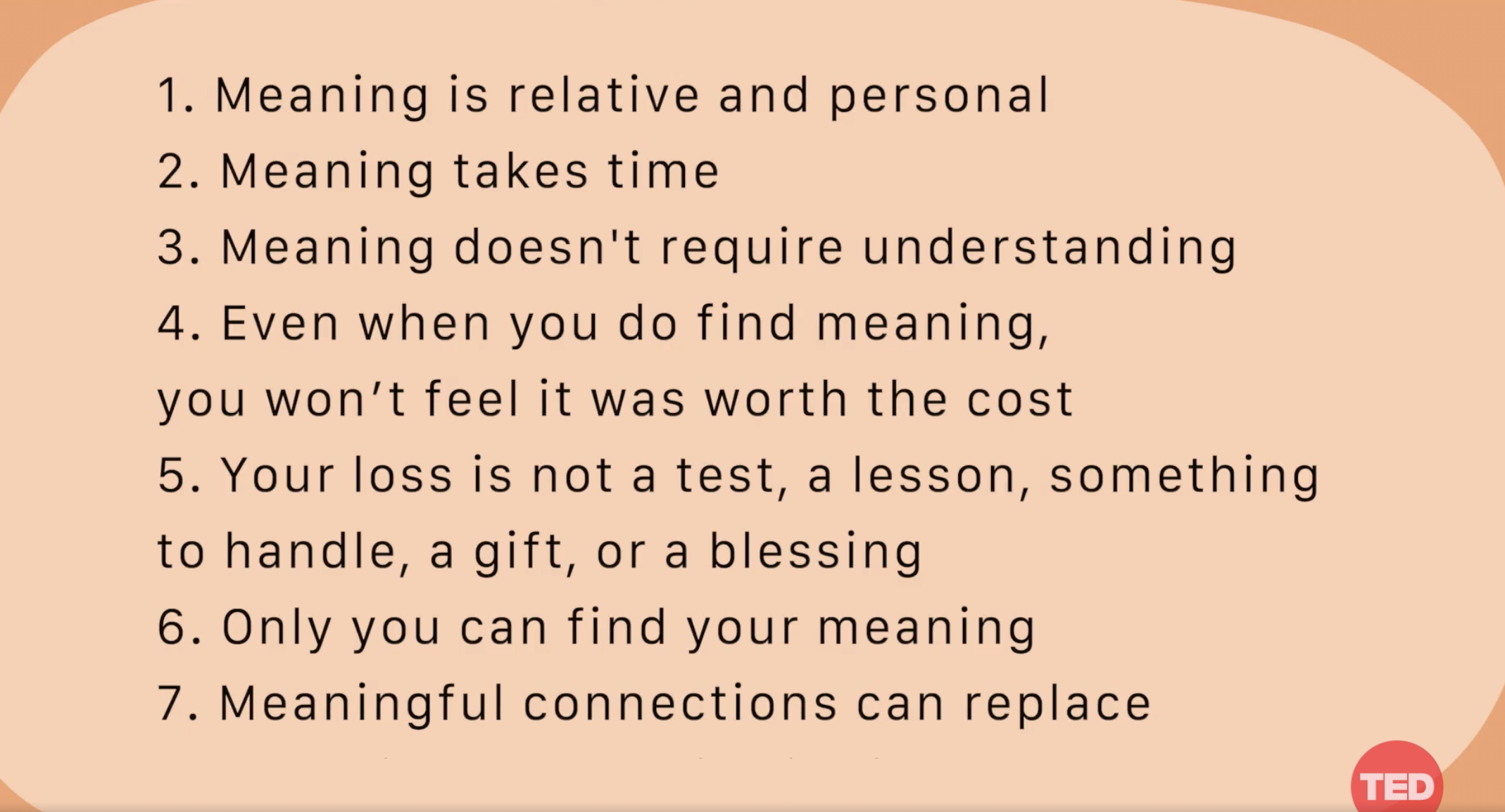

Image generated using Chatgpt
I remember reading this behaviour improvement for leaders in Marshall Goldmsith’s book, “What Got You Here Won’t Get You There”, and have experienced and observed this play out in most organizational/leadership settings in multiple geographies. This is a really important leadership behaviour that has high linkage to team member engagement and commitment.
Marshall posted the following notes recently on LinkdedIn:
“A classic challenge for smart, successful leaders – especially leaders with technical backgrounds (like engineers) – is ‘adding too much value’.
What does this mean?
Imagine that I report to you. I am young, smart and enthusiastic. I come to you with an idea. You think it is a great idea. Rather than just saying, “great idea” our natural tendency is to say, “Why don’t you add this to it?”
Here is the problem. Although your ‘added value’ may make the quality of the idea 5% better. It may decrease my commitment to make it work by 50%.
Your direct report may be feeling, “It is no longer MY idea boss. Now it is YOUR idea.”
David Ulrich, taught me that, “Effectiveness of execution is a function of A. the quality of the idea – times – B. my commitment to make it work.
As a leader, before ‘adding value’, think, “Will my comment increase the commitment of the person I am talk to right now?”
If the answer is, “no”. Then ask yourself, “Is it worth it?”
Sometimes it is. Often it is not.
These few seconds of reflection can go a long way in helping you build commitment, and ultimately empower, the members of your team. ”
Improving this impactful behaviour as a leader takes awareness, reflection, and continued practice. Effectiveness of execution anywhere does look to be a function of the quality of the idea and the commitment to make it work. It would serve you well as a leader and manager to remember this.
Noticed a great article related to career management and performance appraisals in the Mint newspaper today (April 13, 2026) – “What Your Appraisal Cannot Tell You About Your Career” by Vineet Nayar, former CEO of HCL Technologies. Such posts hold increasingly valuable food for reflection in the fast evolving world of work.
Selected notes from the article:
* Layoffs, cautious hiring and rapid shifts driven by technology have made careers less predictable than before.
* What exactly is an appraisal measuring?
At best, it is a snapshot of performance at a point in time, shaped by business priorities and managerial judgment. At worst, it captures activity but misses what really matters. Yet, careers are often judged through this narrow lens.
* Careers rarely stall because of one bad rating. They stall when we treat that rating as a verdict instead of what it really is: a signal.
* Clarity comes from three simple questions:
1. Purpose – Why are you doing what you are doing?
(There is no right answer but there must be a honest one.)
2. Choice – Why this role, this organisation, this path?
(Layoffs have shown that staying put is not always safe. Questioning your choices is uncomfortable but necessary. The difference between a chosen path and a carried path is the difference between ownership and drift.)
3. Driver – Why are you, specifically doing this?
(In a market where many people have similar skills, the real question is not whether you are good at your job. It is whether you stand out. Is your effort driven by a genuine desire to build something meaningful?)
* The real risk today is not a poor rating. It is letting that rating decide your direction.
* Your career is not defined by a number on a form. It is defined by the answers you are avoiding.
The three questions are worth spending time on and building clarity.
Noticed refreshingly different perspectives from Mayank Rautela, Group CHRO at Apollo Hospitals – regarding how kindness is not just a “soft skill” but a business imperative and how it can be strategically embedded into leadership. There are some valuable notes for reflection, especially for healthcare leaders everywhere and the interview (referenced below) is worth reading.
Selected notes from the interview with ETHRWorld:
* Genuine human connection is profoundly contagious. It transforms a transactional environment into a compassionate one, inspiring others to pay it forward and shaping a culture where compassion is the norm, not the exception.
* Kindness is a strategic driver of performance. It’s the foundation of psychological safety…We’ve consistently observed that teams that practice kindness most also have the highest engagement, lowest attrition and better clinical outcomes. Research validates this link: empathy in care leads to greater patient loyalty and trust.
* For a leader, kindness is a core competency, not a soft trait. It’s about leading with authentic empathy and vulnerability.
* We are conditioned to prioritise efficiency over empathy, and many feel they simply don’t have the time to be kind. The real issue isn’t a lack of desire, but fear that kindness may be seen as weakness.
* Kindness must be an institutional commitment, not an accident…also lives in the way we celebrate our people.
* We balance performance with empathy by making kindness integral to our HR strategy.
* Kindness endures when it is deeply woven into the fabric of an organisation’s DNA – through its values, everyday behaviors, recognition systems, and leadership practices…cannot be a one time initiative, must be a way of life.
Source:
Kindness isn’t soft — it is strategy: Apollo Hospitals’ Mayank Rautela on reshaping workplace culture; ETHRWorld; October 1, 2025.
These are valuable notes on CEO/leadership stress, from a recent BCG article, ‘The Physically and Mentally Fit CEO’.
* When a CEO burns out, entire companies feel it, with thousands of livelihoods hanging in the balance.
* “Lots of cognitive studies show decision making gets poorer when you’re fatigued or burned out or mentally stressed…If you don’t have the mental space, the clarity, the conviction, and the energy to do the job, you are hamstringing the enterprise.”
* Media glare only compounds the pressure, turning leadership into a 24/7 performance watched by investors, employees, and the public.
* There are actions CEOs can take to help them spot the signs of burnout and build greater physical and mental resilience.
* “Corporate environments typically lack structured debriefings after highly stressful events”. “In the military, personnel debrief after missions, or in hospitals, teams may debrief after traumatic medical events. These sessions help individuals process what happened by sharing the experience with colleagues, which further reduces stress, and fosters resilience.”
* “It’s rare for almost any human being to spend significant time in a flow state.”
Five Actions for Building Physical and Mental Resilience
1. Get enough sleep.
2. Manage your energy—as well as your time.
“..research suggests that when CEOs use even a few of those resources in their personal lives they can be more intentional about the time they free up for sleep, for exercise, for friends and family-as well as for more effective work”
3. Ruthlessly delegate.
4. Make time for reflection.
5. Establish peer networks.
“..feel less isolated, more energized, and gained an advisory group of peers…”
—
Source:
The Physically and Mentally Fit CEO; BCG; James Brownsell; August 5, 2025
There’s a lot of information, knowledge and wisdom out there, easier accessible than ever before, probably a lot more than most can process.
In this scenario, the critical differentiator skill will start with the ability to understand and discern what’s more valuable, relevant and applicable. Knowing where to look, understanding the context/relevance, who you decide to follow, interpreting, applying/practicing in one’s own environment, reflecting on what worked/didn’t, figuring out alternative sources and approaches – all contribute to that differentiation.
If you think the approaches an AI agent suggests will resolve everything, there may be unpleasant surprises waiting. It may only be treated the starting point of an explorative journey.
A more impactful personal differentiation in a fast evolving world can only be possible through a combination of continuous learning, active reflection and diverse/enriching experiences.
This is why I think, even in an AI and information rich world, there is an important role/seat for real wisdom. It leaves an important question – is the number of people who can recognize wisdom reducing fast?
Could one recognize wisdom better as one becomes wiser?
In today’s world, there’s a tendency to glorify everything that an entrepreneur who is perceived to be successful does with their leadership approach. There are multiple risks in taking that approach.
The following notes from a recently published article remind us about it.
“…the most effective leaders aren’t radically transparent; they are strategically self-aware. They know when to adapt, how to filter, and which version of themselves is most useful in a given situation. If “being yourself” means ignoring feedback, resisting self-regulation, or broadcasting your every mood swing, it’s not authenticity, it’s self-indulgence. And when your decisions affect thousands of employees or millions of users, indulging your quirks becomes a liability, not a virtue.
In short, there is a fine line between charisma and narcissism, between vision and delusion, and between confidence and arrogance. When we admire entrepreneurs, we should separate their contributions from their character. Otherwise, we risk turning toxic traits into aspirational goals, and forgetting that success is not a moral justification for how you got there…”
-From “The four leadership qualities you should not admire in famous entrepreneurs”; Fast Company; August 5, 2025; Dr. Tomas Chamorro-Premuzic, Chief Innovation Officer at ManpowerGroup
About Tojo Eapen

Leadership Coach, Consultant, HR Leader with diverse, global experiences (U.S.A, Europe, APAC).
Master of Human Resource Management from Rutgers University, New Jersey, U.S.A. Recipient of the U.S. Garden State Council SHRM HR Leadership Scholarship.
Bachelor of Technology in Civil Engineering from College of Engineering, Trivandrum, India.
Certifications: MBTI, Hogan, RBL Leadership Code, SHL 360, Team Management Profile, NeuroLeadership Results & Team Coaching.
Facilitated coaching sessions, workshops and programs with multicultural teams in Helsinki, London, Berlin, New Delhi, Bangalore, Kerala, in addition to multiple Global/Virtual sessions.
Mission: Enable healthy, purposeful, and impactful organizations, through leadership knowledge and wisdom.
Contact


© 2026 Lead-Wise
Theme by Anders Noren — Up ↑









Recent Comments