I was going through the 2023 Harvard Business Review article by London Business School professor, Herminia Ibarra and thought the following notes are valuable to share. These provide valuable advices and notes for reflection in a fast changing world of work.
* With increasing frequency, we are changing jobs and careers, pursuing opportunities and making time for rest and restoration.
* Need to learn how to make the most of the frequent transitions.
* You’re likely to experience the transition as an emotionally fraught process.
* Change is hard primarily because of the lack of institutional support and loss of professional identity.
* Usually, we fail to change because we don’t know how to go about it.
* Emotionally, career change is a roller coaster ride because it puts you in a “liminal state” – where you must navigate between a past that’s over and a future that’s uncertain.
* You must embrace liminality. You have to be willing to get and stay lost for a while.
* 3 ways to make that process easier – experiment with divergent possibilities while delaying commitment to any one of them, adopt ‘either-or’ thinking (exploring while maintaining something, at least initially), and building new connections and relationships of kindred spirits.
* We all need a secure base from which to explore the unknown and turn painful feelings/experiences into sources of growth.
* Self-reflecting out loud” is important. We need to get comfortable with the “learning plot” – our story of ongoing struggle and adaptation. As constant reinvention becomes the norm, the stories that define us have no start or ending.
* Proficiency in being liminal will increase your capacity to successfully navigate present and future transitions.
Source:
Why Career Transition Is So Hard; Herminia Ibarra; Harvard Business Review; November-December 2023
PURPOSE & IMPACT
Category: Change
A recent IMD business school article highlights the importance of psychological safety in organizational AI transformation, based on related experiences, from Kameshwari Rao, Global Chief People Officer at international digital consulting firm Publicis Sapient. This also provides useful notes for leaders who are thinking about or working through AI related transformations.
These are selected notes from the article.
* Organizations need a psychologically safe environment for their employees to innovate and experiment.
* Unless employees feel psychologically safe, it is unrealistic to expect them to engage with, let alone embrace, the technology. Inevitably, user hesitation will impede organizational efforts to explore AI.
* Important to remember that “People’s identities are at stake”.
* Human intelligence has been evolving for hundreds of thousands of years, developing characteristics such as empathy, resilience, and judgment to adapt to a changing environment. The role of leaders is to remind people that they possess those irreplaceable human qualities.
* Requires businesses to commit to increased communication and support that considers each employee’s personal reaction to the technology and allows them to adapt at their own pace.
* Publicis Sapient focused on three simultaneous strands of AI change:
1. the shift to a mindset of curiosity rather than anxiety about AI,
2. building confidence, and
3. integrating AI tools into everyday jobs.
* “We wanted to begin the conversation by getting everybody to have a bit of fun with AI. It was about building familiarity.”
* The town hall was followed with a dedicated campaign, AI Habits, where the goal was to pique curiosity, with initiatives based on psychological research into habit formation.
* At the same time, Publicis Sapient prioritized experimentation, getting people to think about the skills and training they might need to make the most of AI. One useful approach here was gamification.
* Note that companies should not see these three AI initiatives as one-and-done exercises: “At any given point, you will have people at different stages in all three areas – everyone’s change cycle is different.”
* Leaders have framed AI as an ongoing learning journey.
* Listening, sharing – a range of listening tools that Publicis Sapient uses to understand whether employees are feeling confident in the workplace. Leaders, starting with the CEO, also serve as role models, share their own anxieties.
* No single initiative will create psychological safety around AI. Rather, it will take a spread of different, ongoing measures.
Source: Publicis Sapient on AI: A three-step guide to psychological safety; IMD; June 8, 2026
The topic of friendship has been in my mind during recent days.
It got me to revisit some notes from a very interesting March 2022 Atlantic article, “It’s Your Friends Who Break Your Heart” (by Jennifer Senior).
Does it hurt more when a friend treats you badly or doesn’t live up to your expectation?
Selected notes/food for reflection from the article:
* You lose friends to marriage, to parenthood, to politics-even when you share the same politics. You lose friends to success, to failure, to flukish strokes of good or ill luck. (Envy, dear God—it’s the mother of all unspeakables in a friendship) These life changes and upheavals don’t just consume your friends’ time and attention. They often reveal unseemly characterological truths about the people you love most, behaviors and traits you previously hadn’t imagined possible.
* …still left out three of the most common and dramatic friendship disrupters: moving, divorce, and death. Though only the last is irremediable.
* The unhappy truth of the matter is that it is normal for friendships to fade, even under the best of circumstances. The real aberration is keeping them.
* One could argue that modern life conspires against friendship, even as it requires the bonds of friendship all the more.
* This is how most friendships die, according to the social psychologist Beverley Fehr: not in pyrotechnics, but a quiet, gray dissolve. It’s not that anything happens to either of you; it’s just that things stop happening between you. And so you drift.
* Failures of reciprocity are a huge theme in broken friendships.
* Psychologist Julianne Holt-Lunstad discovered in 2003, when she had the inspired idea to monitor her subjects’ blood pressure while in the presence of friends who generated conflicted feelings. It went up-even more than it did when her subjects were in the presence of people with whom they had “aversive” relationships. Didn’t matter if the conversation was pleasant or not.
* Practically everyone who studies friendship says this in some form or another: What makes friendship so fragile is also exactly what makes it so special. You have to continually opt in. That you choose it is what gives it its value.
* Friendship is the rare kind of relationship that remains forever available to us as we age. It’s a bulwark against stasis, a potential source of creativity and renewal in lives that otherwise narrow with time.
* What do you do with friendships that were, and aren’t any longer?
By a certain age, you find the optimal perspective on them, ideally, just as you do with so many of life’s other disappointments.
—
There also seems to be a neuroscience connection.
“Brain neuroimaging study revealed that the brain areas that are activated during the distress caused by social exclusion are also those activated during physical pain. Thus, we have an explanation for the feeling of physical pain that accompanies emotional loss-whether that be the loss of a loved one or rejection by one’s social group.”
– Neuroscience. Feeling the pain of social loss; Jaak Panksepp
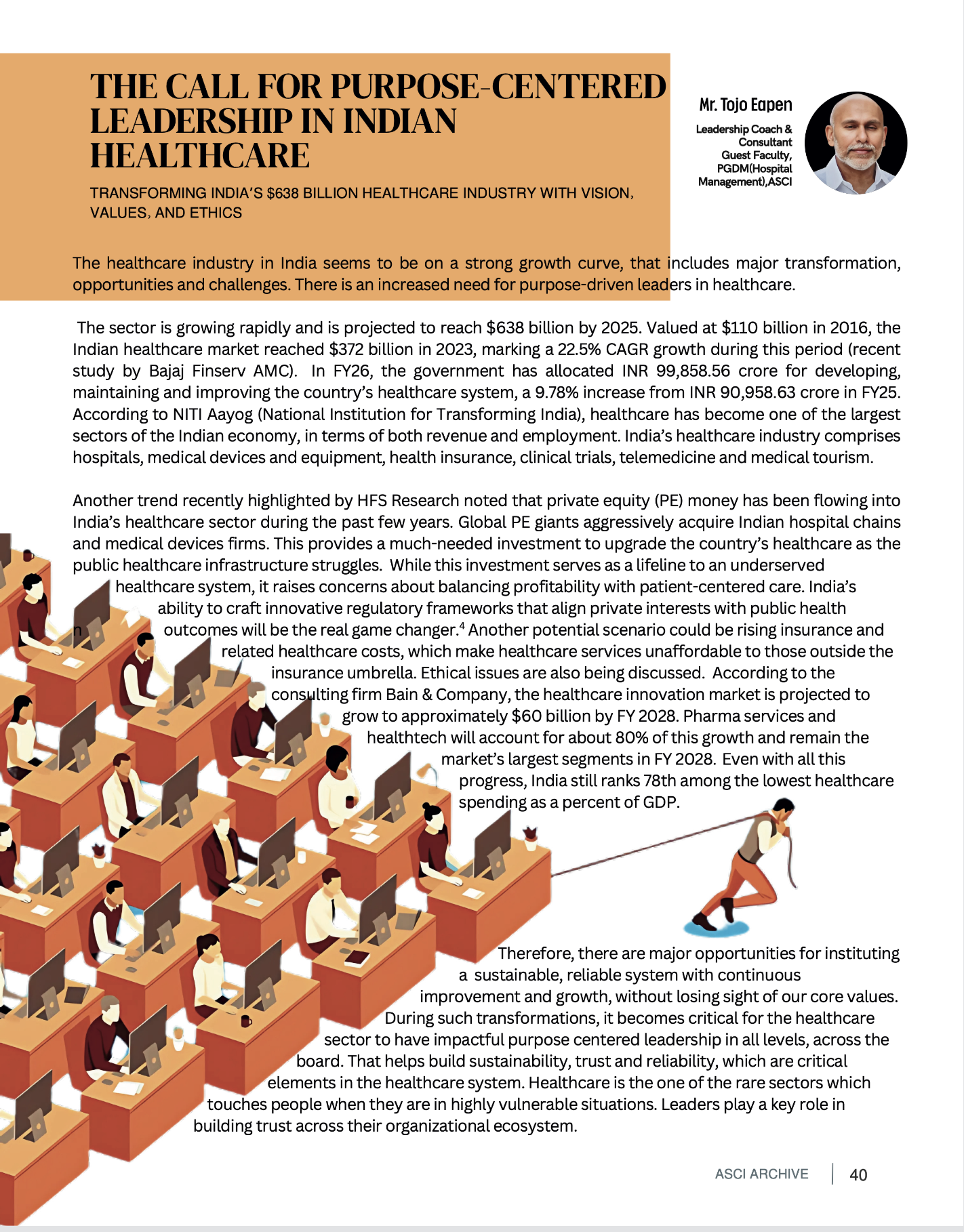
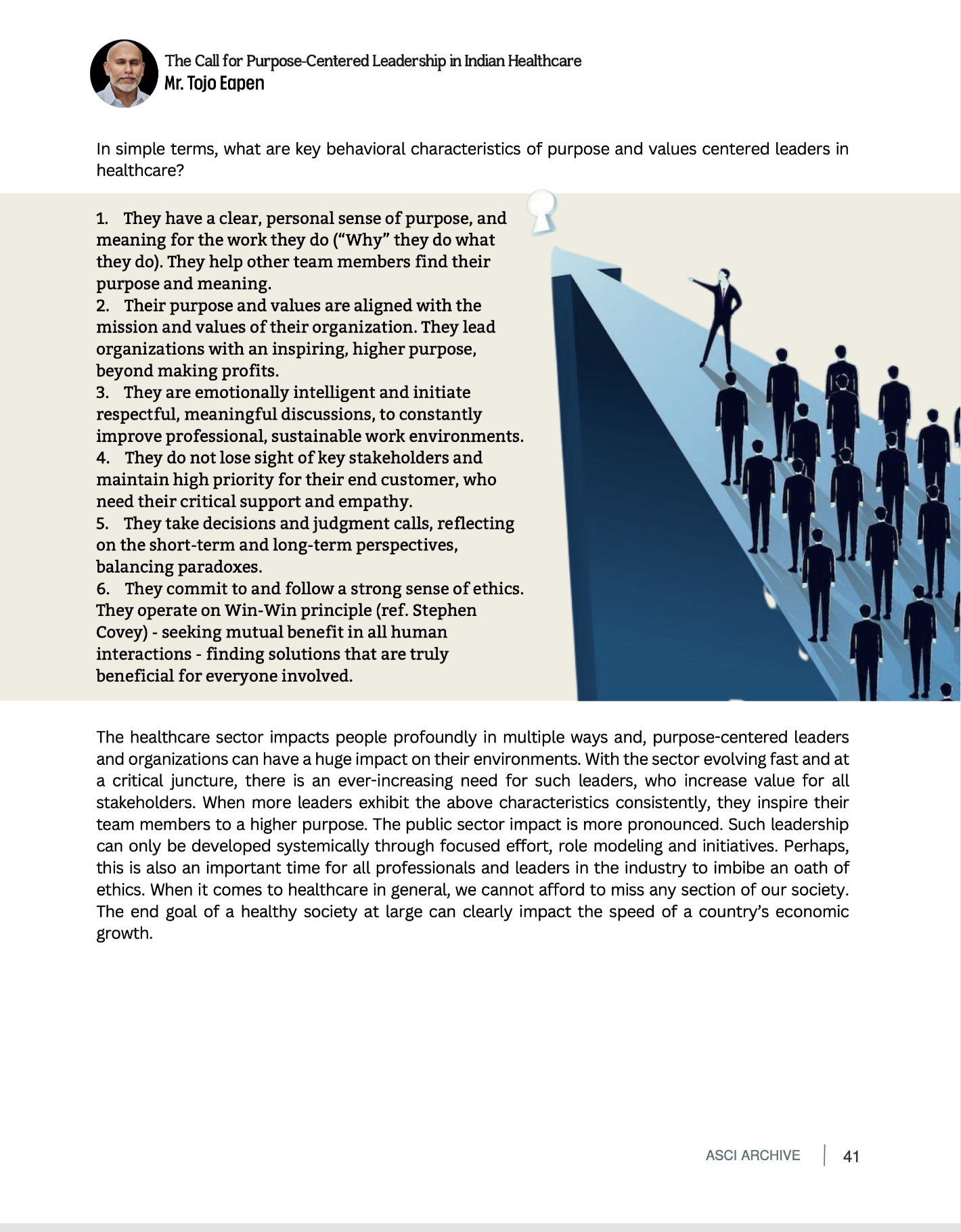
Sharing a recent article I wrote, titled, “The Call For Purpose-Centred Leadership In Indian Healthcare” for the Administrative Staff College of India, Post Graduate Diploma in Hospital Management (Hyderabad) program magazine.
Our healthcare sector requires transformational leadership that positively impacts our larger society and stakeholders, as it evolves.
If you have seen the news about DeepSeek in recent days (including rattled financial markets) and are wondering what the noise is all about, why this is disruptive, important and relevant, this video below from CNBC is a helpful watch. It includes an interesting interview with Perplexity CEO, Aravind Srinivas, with pertinent questions and inputs (from early Jan ’25).
In this week’s Business Standard, an article stated that “DeepSeek has become the most downloaded app on Apple App Store in India across all categories, according to data from Sensor Tower… It was released worldwide on January 10, with an update on January 27…
DeepSeek is the most downloaded app on Apple Store in the US… On Play Store, it is the second most downloaded app…
However, in countries like the UK, Australia, Singapore and Canada, it already hit the number one spot amongst all apps on January 28. But it has not made a similar domination in most European countries.”
This development seems to have taken most experts by surprise. The achievement, speed, budget, resources and context of all this could be a valuable case study in itself. Some countries are already thinking/concerned about the security and ethical aspects as well.
There’s been a lot of attention and discussion related to the unfortunate recent death of an employee in a large company in India, related work environment and practices. The fact that this is being shared, discussed heavily on social media and the media, indicates this topic has touched many people deeply.
* As business founders, leaders, managers and HR professionals, it is important to be proactive in ensuring healthy work environments in your organisations. This includes the focus on work, organization culture, policies and practices, leadership behaviors, health and wellbeing of your team members.
* All of you have important, shared responsibilities which impacts lives of your employees and their families.
* Doing nothing or staying silent never helps and most times, silence encourages toxic behaviours. Psychological safety is a core element of a healthy work environment. At a minimum, it is critical to initiate constructive discussions/dialogues with the long term interest of your people and sustenance of your organisation in mind. Do not brush the uncomfortable discussions away. Start with few fundamental steps that may hold high impact and visibility. Figure ways to manage stress proactively, actions to take when the red light indicators show up (they will show up in some form). When groups of managers and leaders work collectively with their support teams, get support and help (internally or externally), things will improve.
* In larger companies, it’s easier to lose sight of individual cases and stay hidden. The stress threshold levels can be different for individuals. Team members play a key role here in identifying, awareness and support.
Don’t let toxic elements/aspects linger and grow till it becomes too late.
For many leaders and organisations, the key learning here is to be proactive and not wait for worst case scenarios (irrespective of direct or indirect causes) to play out.
On the other side of the coin, many professionals and companies have high ambition and drive (that’s normally the path to quick growth) but that needs to be balanced with the constant reminder that the work is similar to a marathon, not a sprint. One needs to be prepared for the marathon. The growth process, and speed will be continuous and one needs to adjust the pace. Companies always are in a race to keep growing. The alternative is gradual decline. It is very important for the individual employee to be equally focused and responsible for safeguarding one’s own health and well being – to ask for support when needed, get help and figure ways to stay healthy physically and mentally. If the organization culture is not supportive, find personal ways to stay healthy. If that doesn’t work still, it is completely okay to find another workplace that works better for you.
The role of leaders in ensuring a healthy work environment is critical.
Chairman of multiple companies, and former CEO Douglas Conant recently said, “Surprisingly, I find that I cannot say it enough.”
…” leadership comes from within, from our humanity. We cannot be “artificial” in any way in our leadership; we must be authentic, true to ourselves, and true to the people with whom we live and work.”
There is a need to reaffirm, remind constantly about the fundamentals of a healthy workplace, and the critical role of positive, healthy leaders. When people spend most of their lives at the workplace, that could make a huge difference.

Image: Pixabay, RoderickQiu
Some of us have seen this happen few times during our lifetimes. A highly successful, global company with thousands of employees and the darling of the press and management books gets into trouble slowly and loses its shine eventually. Thousands of jobs are cut, announced in phases over years and the decline become more visible gradually. Issues become too big to ignore, other companies start taking over market share and breakdowns become more frequent with increasing number of unhappy customers. Few revered corporate names have been visible in the press for these reasons, even during the last week. This has happened to non-profit organisations as well.
The golden mindset to protect dearly during success is conscious humility.
A 2016 HBR Article (The Scary Truth About Corporate Survival) noted that 80% of the companies that existed before 1980 were no longer around. Professors Vijay Govindarajan and Anup Srivastava looked at all companies that listed on U.S. stock markets from 1960 to 2009 and confirmed that longevity is decreasing. Companies that listed before 1970 had a 92% chance of surviving the next five years, whereas companies that listed from 2000 to 2009 had only a 63% chance. They wrote that the bad news for the newer firms is that their days are numbered, unless they continually innovate. In short, even seemingly successful and rich companies can fall into a fight for survival sooner than expected.1
From a behavioural perspective, a consistent common pattern is noticeable. As companies become more successful, arrogance tends to creeps in. When this happens at the leadership levels and manifests in decisions, judgment calls and cultural elements, the damage can be enormous. Most times, the degradation is not evident quickly. This may show up in the form of increased ignorance of contradicting views and potential risks, lack of openness, increased feelings of invincibility, sometimes even translating to visible disrespect. For leaders, even listening to varying perspectives from internal stakeholders goes down. There is a rigid focus on “our approach, our process and we know what is right” thinking. Stakeholders outside the organisation most times see this degradation earlier than those inside. Even at this stage, the general feeling is that nothing could go wrong. Leaders can also become overly focused on themselves. While some leaders may seem to be humble at a personal level, it’s important to watch out for reduced humility at an intellectual level (eg. openness to discussing varying and contradicting perspectives, disregarding others quickly).
The mindset of conscious humility and curiosity are closely related. Genuine curiosity comes from being humble about one’s own views and openness to others. Conscious humility are also related to compassion and empathy. Behaviours are consistently leading indicators of organisational unhealthiness and degradation, while the slowing business results may show up much later. Once the negative impact on business results indicates a pattern, it becomes hard to turn around the ship quickly. The focus then shifts to cost cutting and prevailing phases of uncertainty, leading to complex environments. Does this sound familiar?
Professor Jim Collins (Good To Great) wrote about the Five Stages of Decline, in the book, How the Mighty Fall. He called Stage 1 the “Hubris Born of Success”. “Great enterprises can become insulated by success; accumulated momentum can carry an enterprise forward, for a while, even if its leaders make poor decisions or lose discipline. Stage 1 kicks in when people become arrogant, regarding success virtually as an entitlement, and they lose sight of the true underlying factors that created success in the first place. When the rhetoric of success (“We’re successful because we do these specific things”) replaces penetrating understanding and insight (“We’re successful because we understand why we do these specific things and under what conditions they would no longer work”), decline will very likely follow. Institutions can be sick on the inside and yet still look strong on the outside; decline can sneak up on you, and then-seemingly all of a sudden-you’re in big trouble. Stage 3 is Denial Of Risk And Peril. As companies move into Stage 3, internal warning signs begin to mount, yet external results remain strong enough to “explain away” disturbing data or to suggest that the difficulties are “temporary” or “cyclic” or “not that bad,” and “nothing is fundamentally wrong.” In Stage 3, leaders discount negative data, amplify positive data, and put a positive spin on ambiguous data. Those in power start to blame external factors for setbacks rather than accept responsibility.”2
While sometimes organisations may be truly unlucky in their journey to get hit with factors outside their control, most times, the start of organisational failures can be traced back to the hubris of success and lack of humility. Leaders play a very important role in protecting and ensuring humility in day to day operations. This starts with role modelling related behaviours and incorporating conscious humility mindset into the heart of thinking, decision making and organisation culture. Ignoring these elements can invite serious repercussions.
In the book, Trillion Dollar Coach, the traits of coachability Bill Campbell sought were honesty and humility, the willingness to preserve and work hard and a constant openness to learning. Honesty and humility, because a successful coaching relationship requires a high degree of vulnerability.3 Openness as well cannot exist without humility. Humility can be developed consciously.
References
- The Scary Truth About Corporate Survival, December 2016
- Five Stages of Decline, Jim Collins
- Trillion Dollar Coach, Eric Schmidt, Jonathan Rosenberg, Alan Eagle
About Tojo Eapen

Leadership Coach, Consultant, HR Leader with diverse, global experiences (U.S.A, Europe, APAC).
Master of Human Resource Management from Rutgers University, New Jersey, U.S.A. Recipient of the U.S. Garden State Council SHRM HR Leadership Scholarship.
Bachelor of Technology in Civil Engineering from College of Engineering, Trivandrum, India.
Certifications: MBTI, Hogan, RBL Leadership Code, SHL 360, Team Management Profile, NeuroLeadership Results & Team Coaching.
Facilitated coaching sessions, workshops and programs with multicultural teams in Helsinki, London, Berlin, New Delhi, Bangalore, Kerala, in addition to multiple Global/Virtual sessions.
Mission: Enable healthy, purposeful, and impactful organizations, through leadership knowledge and wisdom.
Contact


© 2026 Lead-Wise
Theme by Anders Noren — Up ↑









Recent Comments