I was going through the 2023 Harvard Business Review article by London Business School professor, Herminia Ibarra and thought the following notes are valuable to share. These provide valuable advices and notes for reflection in a fast changing world of work.
* With increasing frequency, we are changing jobs and careers, pursuing opportunities and making time for rest and restoration.
* Need to learn how to make the most of the frequent transitions.
* You’re likely to experience the transition as an emotionally fraught process.
* Change is hard primarily because of the lack of institutional support and loss of professional identity.
* Usually, we fail to change because we don’t know how to go about it.
* Emotionally, career change is a roller coaster ride because it puts you in a “liminal state” – where you must navigate between a past that’s over and a future that’s uncertain.
* You must embrace liminality. You have to be willing to get and stay lost for a while.
* 3 ways to make that process easier – experiment with divergent possibilities while delaying commitment to any one of them, adopt ‘either-or’ thinking (exploring while maintaining something, at least initially), and building new connections and relationships of kindred spirits.
* We all need a secure base from which to explore the unknown and turn painful feelings/experiences into sources of growth.
* Self-reflecting out loud” is important. We need to get comfortable with the “learning plot” – our story of ongoing struggle and adaptation. As constant reinvention becomes the norm, the stories that define us have no start or ending.
* Proficiency in being liminal will increase your capacity to successfully navigate present and future transitions.
Source:
Why Career Transition Is So Hard; Herminia Ibarra; Harvard Business Review; November-December 2023
PURPOSE & IMPACT
Category: Career (page 1 of 2)
Noticed a great article related to career management and performance appraisals in the Mint newspaper today (April 13, 2026) – “What Your Appraisal Cannot Tell You About Your Career” by Vineet Nayar, former CEO of HCL Technologies. Such posts hold increasingly valuable food for reflection in the fast evolving world of work.
Selected notes from the article:
* Layoffs, cautious hiring and rapid shifts driven by technology have made careers less predictable than before.
* What exactly is an appraisal measuring?
At best, it is a snapshot of performance at a point in time, shaped by business priorities and managerial judgment. At worst, it captures activity but misses what really matters. Yet, careers are often judged through this narrow lens.
* Careers rarely stall because of one bad rating. They stall when we treat that rating as a verdict instead of what it really is: a signal.
* Clarity comes from three simple questions:
1. Purpose – Why are you doing what you are doing?
(There is no right answer but there must be a honest one.)
2. Choice – Why this role, this organisation, this path?
(Layoffs have shown that staying put is not always safe. Questioning your choices is uncomfortable but necessary. The difference between a chosen path and a carried path is the difference between ownership and drift.)
3. Driver – Why are you, specifically doing this?
(In a market where many people have similar skills, the real question is not whether you are good at your job. It is whether you stand out. Is your effort driven by a genuine desire to build something meaningful?)
* The real risk today is not a poor rating. It is letting that rating decide your direction.
* Your career is not defined by a number on a form. It is defined by the answers you are avoiding.
The three questions are worth spending time on and building clarity.
These are some interesting notes from a Business Standard article today related to higher education in India (based on a report, titled “From Degree Factories to Employability Hubs”, released on Monday by TeamLease EdTech). In future, would there be increased emphasis on placement and career outcomes?
* Fewer than 20% of higher education institutions in India manage to place more than 75% of their students within 6 months of graduation.
* 31.6% placed between 51% and 75% of students.
* Nearly 29% of institutions reported placement rates below 25%, underscoring wide disparities in employment outcomes across institutions.
* The report highlights persistent gaps between academic outcomes and labour market expectations, even as universities and colleges increasingly prioritise job readiness.
* Higher education institutions must move beyond traditional classroom-based models, and integrate practical exposure, internships and industry linked training into academic programs.
* 86% of institutions say their curricula are fully aligned with industry requirements across all programmes.
* Roughly a quarter of institutions show some degree of industry alignment, suggesting that efforts to connect academic programmes with labour market needs remain limited and uneven.
* Industry collaboration is expected to play a critical role in improving employability outcomes.
* The report suggest that institutions may increasingly be judged not just on enrolment and academic performance, but also on placement outcomes and long-term career progression of graduates.
Source: Fewer than 20% colleges achieve strong placements: Report; Business Standard; Auhona Mukherjee, March 23, 2026
I came across a very relevant and interesting opinion piece in the Business Standard today, titled “Startup Fever” by Ajit Balakrishnan.
Some important notes from the author that got me thinking:
—
“…what gives me sleepless nights is that in India, amid all this clapping and cheering abouts startups, at policy making level we need to dive a lot deeper into the startup process…
Statistics from the United States and India show that nine out of ten startups don’t make it; ie. only 10 per cent survive and prosper.
A further analysis shows that 20 per cent of startups fall apart after a year, another 30 per cent close down within two years, 20 per cent shut their doors within five years, and the remaining 20 per cent dissolve within ten years…
Which conveys learning to deal with failure in a startup venture appears to be as important, if not more important, than learning to celebrate success.
…Statistics reveal that the most important reason for failure among startups is that the product/service created does not appeal to the market (market fit).
Second – initial funds startup had at its disposal are used up too quickly.
Third – failing to hire the right people. The founders should complement each other’s skills.
The final reason for failure – something that could happen in the environment beyond your control but damages your business…”
—
The opinion piece starts with a reference to an individual suicide scenario, potentially of a startup founder.
Our world tends to celebrate only the few startup successes. Is there a way to cherish the learnings and journeys of those that fail?
Startup founders and teams live through constant high stress and pressure. It is critical to work through the challenges together as a team, and build a healthy internal environment that supports each other during times of both success and failures. The impact of leadership mental and physical health could roll over into many areas, including health of the organization. Don’t leave people hanging, and share graciously during success as well. In the larger context and meaning of life, the universe seems to have a way of balancing. There are various aspects of the organization that can be analysed and improved.
External support networks and the systemic support could be game changers for leaders who may feel lonely. Sometimes, for those who have not faced any previous major failure in life, a major failure like this can be debilitating. Finding ways to cherish the journey and experience, relationships, building personal and organizational resilience (including learning to work through failures), and connecting the dots to larger context (seeing it as part of evolution) can add to the meaning of work and life.
This also reminded of a famous quote from Steve Jobs.
“You can’t connect the dots looking forward; you can only connect them looking backwards. So you have to trust that the dots will somehow connect in your future. You have to trust in something—your gut, destiny, life, karma, whatever”.

During recent weeks, I got into discussions with few parents who were thinking about career tracks to guide their children. The idea for writing on this topic came from one such discussion. This topic seems to be more active on the minds of many parents as their children get closer to the tenth and twelfth standards at school.
From my observations of working professionals and students, there are at least 3 fundamental elements while thinking about your child’s career.
1. Passion/genuine interest
This is probably the most critical element to consider. It’s normally easy to spot uninterested students in classrooms and employees in the workplaces across the world through their low commitment, engagement and efforts. While speaking with students in post graduate programs, it becomes easy to observe those who are genuinely engaged and interested (even when they are introverted). When individuals go into areas of low interest or are pushed by family, they tend to migrate to becoming average at learning/outputs and disengaged quickly. During long working careers, passion or genuine interest will drive one’s will and energy to keep going through the inevitable challenges and difficult times. Internal motivation also helps develop extra edge through proactive, continuous learning and growth over others.
2. Natural strengths, preferences and related tracks
Every individual has natural strengths and preferences in certain areas. It’s important to actively recognise, encourage, grow those strengths, figure out areas where these strengths can be applied naturally and actively. At the same time, it would be practical to think if those areas can lead to healthy compensation and life support. Sometimes, there may be adjoining work areas to explore and understand that require similar strengths. On the unhealthy side, many parents prioritise potential compensation or perks as the top point with good intentions but that may set their children up for potential unhappiness, disillusionment and immense stress in following years. Some tend to become miserable over time, feeling stuck, resulting in unhappiness and frustration across professional and personal environments.
An individual with a high degree of passion, interest and natural strengths has a much higher chance of getting noticed, becoming successful rather than working in areas where the above elements don’t exist (even when the tracks don’t seem very promising in the eyes of the world). This should not be about just finding the first job but rather thinking beyond into longer career tracks, meaning, impact and growth.
3. Clarity on areas of low interest
Even if one many not be aware of what to choose, it helps to be clear on what is not enjoyable or probably even hated by your child. These areas should be clearly avoided even when there’s lot of peer/social status pressure and seem to hold potential for high earnings or opportunities.
Many children may not be aware of their own strengths, preferences and related career tracks to explore. Schools can play a key role in that process by ensuring supporting resources, assessments, counseling and career guidance initiatives. Experimentation, getting exposure and exploration, when unclear should also be actively encouraged. Many times, lack of awareness of opportunities or career options become a big gap for students and parents. It’s important to start somewhere, even if small. If there is a sense of enjoyment and engagement, that’s a good work fit indicator. Externship and internship programs may help.
It is also always helpful to have few alternatives keeping in mind the above elements. Some experiences may lead to changing opinions on interest after a reality check.
Another helpful advice is to discuss actively with your network, experts in related areas and use all opportunities to understand more about different career tracks. Encourage your child to take accountability and responsibility to work hard in their chosen area of interest. When they feel the decision is predominantly based on their interest, their commitment and accountability tend to be much higher. That translates to a higher probability of success, engagement and enjoyment at work. There’s also a lot of supporting information available online.
From a broader perspective, when the world gets the right fit of passionate, highly engaged people in jobs (including seemingly boring or uninteresting jobs), the potential for achievement and engagement is huge. That also leads to enjoyable experiences for all stakeholders – leading to win-win outcome for society at large.
During my personal discussion, it was refreshing to see that my connection had noticed his daughter’s increasing passion and strength around culinary skills and was open to supporting her in that direction, while staying open to understanding alternatives and having a plan B based on her strengths. That approach increases the probability of success and thriving in her career.
“Passion is energy. Feel the power that comes from focusing on what excites you.”
—Oprah Winfrey
Many current and aspiring leaders across the world grapple with a basic question:
What areas of competencies are needed to become an effective leader?
My first podcast focuses on the required awareness of fundamental leadership capabilities and the four competency areas for leadership success in any environment.
This is a video of my recent talk for engineering students and educators at an International Conclave, organized by the ICT Academy of Kerala, India. The key points covered here were shared earlier in a related blog post,
Prepare Students For Future World Of Work – 3 Behavioral Elements

We recently saw in the press about an employee situation in a leading IT organization in India. HR was blamed by many. There will be many occasions in organizations that involve difficult situations to execute and the pressure seems high. One of the most common reasons cited in such situations is financial pressure.
Many times, a different contradicting view is not raised by HR because of the fear for their own jobs, to avoid conflict with the leaders who are more powerful, whose support is needed and to avoid personal issues. Business leaders play a key role in making their HR teams comfortable and confident for such discussions.
An important lesson for HR professional here is to clearly listen to oneself, think from multiple perspectives and highlight one’s point of view, when experience and conscience clearly tells something is amiss. You have to take responsibility for a decision that you are involved in and highlight concerns at the time of review. When a delicate situation goes out of control later, you will most probably see others pointing towards you, though you were not the only person in that room. Sometimes, these may involve ethical scenarios that can come back and haunt the organization in a major way (eg. recent harassment claims in a prominent U.S. organization). The situation may require you to take a clear stand that sometimes creates tension.
For any professional, it is also important to build your credibility by constantly interacting with all key leaders regarding your points of view. One needs to develop trust, skill, knowledge and credibility to initiate and influence such discussions.
Poor leadership is seen when business or organizational leaders hide behind HR teams for decisions made and don’t feel comfortable communicating themselves. The best business leaders take responsibility for leading their organizations, initiate discussions through leadership channels and actively partner with their HR teams. They form a great partnership to build an engaged culture and everyone wins in the process, especially the organization. As an HR professional, it is important to realize you are ultimately safeguarding the organization and key stakeholder interest when you bring different and sometimes contradicting perspectives to a complex discussion.
I once interacted with a headhunter team who were sourcing for a HR Head in a startup. They seemed to become upset and dismissive on being asked related questions and ended up responding quite unprofessionally. It made me wonder that if they could not tolerate detailed questions about the organization while searching for an HR leader, what sort of HR professional and team would be hired.
We see this aspect become increasingly relevant for organizations to acknowledge. Many times, issues and scenarios go out of control because of the “How”, not the “What”. In today’s world, where everyone has access to both channels and sources of information, the professional and balanced HR perspective internally or externally, becomes critical for every professional and organization to develop, succeed and thrive.
Most people tend to think about their career progression and growth in a linear manner – i.e. work my way up the ladder and end in a senior or leadership position before retirement.
In today’s evolving and constantly changing world, one needs to think about the career topic with a different perspective. Environments change quickly, business shifts happen unexpectedly, impacts are felt globally, leaders and strategies change faster than one expects.
The concept of ‘stretch’ and growth needs to be constantly on one’s agenda. Complexity in different forms ensure learning and growth. As a result, we develop learning agility and it becomes a fundamental element of our approach and way of working. As we widen our ability to think, adapt and grow, we increase our value to any organizational setting.
Here are some fundamental questions to think about in this approach. The deeper and longer term aspects have to be addressed first.
1. What do I want to achieve with my life? What is meaningful success for me? What capabilities, support and paths do i need to build?
2. Am I continuing to grow or learn new things (in an area of importance, aligned to my longer term career objective), irrespective of the position or responsibility I hold today?
3. How long have I been doing the same work (irrespective of the job or role), without changing any element? Can I think of different approaches?
4. Key elements of role changes I would want to explore:
a. Breadth of responsibility at different levels
b. People Management – direct, indirect, matrix
c. Culture – Geography, Organization
d. Organization size, background and structure
e. Business environments – startup, fast growth, mature, major changes
f. Local & Global roles
4. Have I explored experience in different types of work approaches – eg. consulting, independent, volunteer etc.?
One can explore options with current organizations to start with or externally, through encouraging leaders and systems who facilitate the right opportunities.
At the heart of it, it may be always worthwhile to ask ourselves a Tom Peters (management guru) question: “What would you like to be written on your tombstone?”
Life is a valuable gift and it is important to think about the impact we want to create and the meaning we want to achieve through our work. After all, we spend a substantial portion of our lives at work and with colleagues.
Wish you the very best and a successful New Year 2015…
To every reader who’ve followed my posts, shared feedback and encouragement, special thanks to you and best wishes.
Posted on LinkedIn on December 25, 2014.
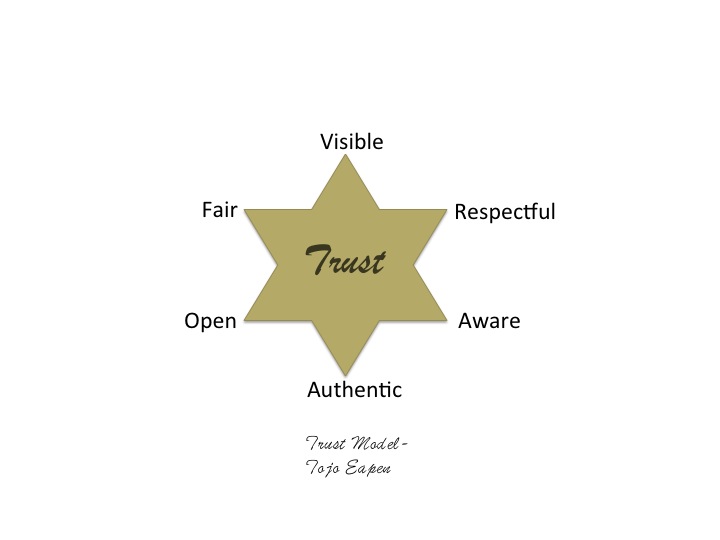
(Posted on LinkedIn on October 21, 2014. Modified version of a previous post on www.tojoeapen.com/blog.)
One of the most common leadership questions and challenges we come across in organizations is “How do I/we build trust?”.
This is a topic that will be constantly revisited by many, in personal and professional lives. Trust can be built more consciously through repeated, consistent actions. Every action and behavior can contribute to building or breaking trust. When a healthy mass of leaders practice trust building behaviors in an organization, it starts to shift and impact the culture positively. You can also build some of these aspects into organizational practices and systems.
1. Be visible.
Don’t get too busy with meetings and spend most time within closed doors. All stakeholders, especially your team members have a high need to see their leaders, even more when uncertainty is high. As human beings, visibility is reassuring and, builds certainty and confidence.
2. Be respectful.
Being respectful in your direct and virtual interactions, irrespective of organizational levels are major acknowledgments and motivators for individuals. The deeper you go in an organization, the more charged up and motivated individuals feel when leaders find time for them. Respecting personal space and feelings, especially during difficult phases go a long way to building commitment and trust.
3. Be aware (of self and impact of your behaviors and actions on others).
Take time to understand yourself, what drives you, your values, principles, strengths and development areas. Self awareness is the starting point of any personal development. Next stage is to understand others around you and the impact of your behaviors on them. Trust is a two way street and someone needs to extend a hand forward first to get the process of interactions into motion. It becomes even more powerful when you extend your hand first.
4. Be authentic (consistent in behaviors and actions).
Be yourself. Don’t try to be someone else. Most people are smart enough to see through ‘fake’ and artificial personalities. This does not indicate the license to do whatever to be yourself, rather this is about being aligned to your values and principles. Practice what you preach. Admit mistakes with accountability when they happen and share recognition when success is achieved. Explain your thinking approach because people may think differently about a certain topic and struggle to see the rationale in another person’s point of view.
5. Be open (to discussions, while being conscious of biases).
Having the openness to discuss aspects that you may not agree with and have a strong view about, may help you see different possibilities and ideas. Sometimes, it helps to be open about the fact that you have a strong view for a certain reason. It also encourages others to share ideas and thoughts without fear. Presence of fear and defensiveness are among the biggest barriers to trust. It becomes more difficult to share mistakes that may come to haunt you later, or to speak up when the perceived power distance or threat of repercussion seems high. Being vulnerable, even to some extent is a big factor for others to see your humanness and increases accessibility.
6. Be fair (in your approach and communicate clearly, especially tough choices).
People can live with tough choices if they feel it was based on a fair process and they’re not being misled into believing so. Many times, lack of visibility on the process or the way it was communicated or an absence of it, results in difficult scenarios and contradictions for everyone involved.
To easily remember, we can also use the acronym ‘FAAVOR‘ (Fair, Aware, Authentic, Visible, Open, Respectful).
It is valuable to reflect constantly. Taking out some thinking time with yourself, your close connections, coaches or mentors can help you in finding more clarity. We all have different scenarios to think about and there are no perfect solutions. Observing, reflecting and adjusting our approaches accordingly would help to figure out an appropriate approach for our environment.
Over time and with practice, building trust becomes achievable and impactful through a concrete set of actions.
About Tojo Eapen

Leadership Coach, Consultant, HR Leader with diverse, global experiences (U.S.A, Europe, APAC).
Master of Human Resource Management from Rutgers University, New Jersey, U.S.A. Recipient of the U.S. Garden State Council SHRM HR Leadership Scholarship.
Bachelor of Technology in Civil Engineering from College of Engineering, Trivandrum, India.
Certifications: MBTI, Hogan, RBL Leadership Code, SHL 360, Team Management Profile, NeuroLeadership Results & Team Coaching.
Facilitated coaching sessions, workshops and programs with multicultural teams in Helsinki, London, Berlin, New Delhi, Bangalore, Kerala, in addition to multiple Global/Virtual sessions.
Mission: Enable healthy, purposeful, and impactful organizations, through leadership knowledge and wisdom.
Contact


© 2026 Lead-Wise
Theme by Anders Noren — Up ↑









Recent Comments