
PURPOSE & IMPACT

Month: April 2026

Human Qualities Most Likely to Matter In Work With AI

Image generated with Chatgpt

There are lots of discussions and debates nowadays regarding the evolution of work with growing AI impact.

Noticed a very interesting article, “Is AI Smarter Than People? It’s complicated”, in the Wall Street Journal (source below). It also highlights inputs from a related experiment, and the human qualities most likely to matter in the evolving world of work.

These are selected notes from the article.
———-
* My research suggests that we’ve been asking the wrong question and drawing the wrong conclusions.
* In an experiment relating to prediction market accuracy, the hybrid teams (human-AI) reached insightful conclusions that neither a human nor a machine could have produced on its own.

* It’s not that these people were more intelligent than others in the study. They demonstrated two important qualities: perspective-taking and intellectual humility.
Perspective taking – ability to genuinely inhabit another point of view.
Intellectual humility – ability to recognize the edge of your own knowledge and sit with that discomfort rather than trying to rush to fill it.
* Perspective-taking requires requires genuine curiosity about minds other than your own. Intellectual humility requires a kind of emotional courage: the willingness to feel uncertain, even a little foolish, in the presence of something or someone that seems very sure of itself.

* These are not the soft skills we typically celebrate.
* What my experiment suggests is that the human qualities mostly likely to matter are the uncomfortable ones: the capacity to be wrong in public and stay curious; to sit with a question…to read a confident, fluent response from an AI and ask yourself, “What’s missing?”…to disagree with something that sounds authoritative and to trust your instinct enough to follow it.
* We don’t build these capacities by avoiding discomfort. We build them, by choosing it, repeatedly, in small ways.
* Most AI chatbots today default to easy answers which is hurting our ability to think critically.
*…the divergence I worry about – the quieter process of people gradually outsourcing the judgment…
* What can any of us actually do about it? Start with the reframe: The goal of working with AI isn’t to get the answer faster. It’s to find what you are missing…use AI as a savant collaborator to explore uncertainty.
* Perspective-taking, intellectual humility and curiosity are traits that can be cultivated.
———-

Source: Is AI Smarter Than People? It’s complicated; Vivienne Ming (neuroscientist, cognitive scientist and author of “Robot-Proof…”); April 25-26, 2026
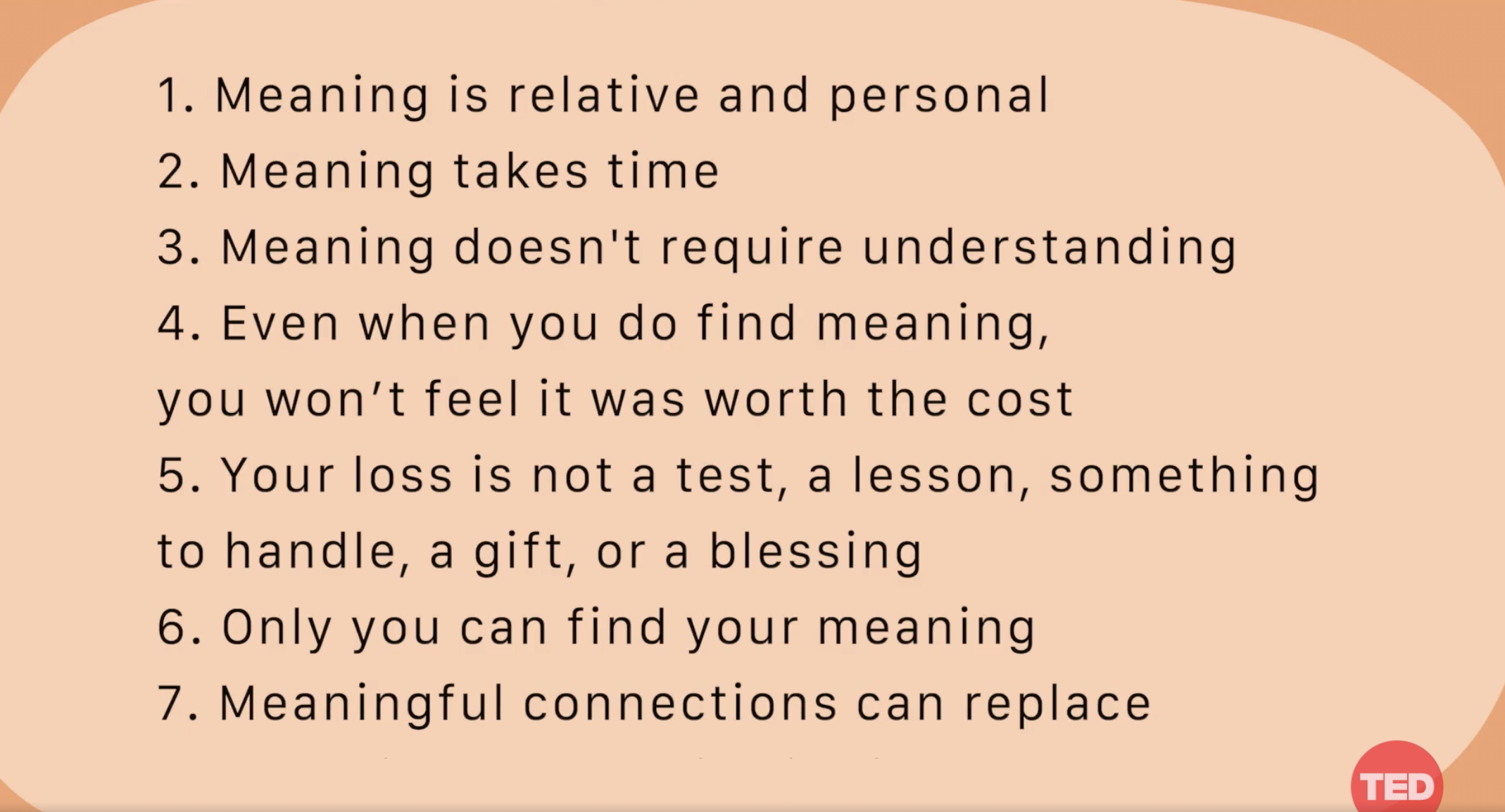

Finding Meaning After Loss

Many people face loss and experience grief in different ways. They move through related feelings and often feel lost. A loss can come in different ways.

Awareness of this topic and how to work through it can help a lot, even to being present for someone going through a loss.
We have heard about the five stages of grief – denial, anger, bargaining, depression and acceptance. 

This is a video, discussion with grief expert, David Kessler that gives valuable awareness and context on the topic. David was a co-author with Elizabeth Kubler Ross (famous for her work on five stages of grief) on the book, On Grief And Grieving. He highlights a sixth stage that is very important – finding meaning.

According to David, there are seven factors that guide the concept of meaning. This is helpful to understand (from the video).

Importance of understanding Commitment from your team members

Image generated using Chatgpt

I remember reading this behaviour improvement for leaders in Marshall Goldmsith’s book, “What Got You Here Won’t Get You There”, and have experienced and observed this play out in most organizational/leadership settings in multiple geographies. This is a really important leadership behaviour that has high linkage to team member engagement and commitment.

Marshall posted the following notes recently on LinkdedIn:

“A classic challenge for smart, successful leaders – especially leaders with technical backgrounds (like engineers) – is ‘adding too much value’.

What does this mean?

Imagine that I report to you.  I am young, smart and enthusiastic.  I come to you with an idea.  You think it is a great idea.  Rather than just saying, “great idea” our natural tendency is to say, “Why don’t you add this to it?”

Here is the problem.  Although your ‘added value’ may make the quality of the idea 5% better.  It may decrease my commitment to make it work by 50%.
Your direct report may be feeling, “It is no longer MY idea boss. Now it is YOUR idea.”

David Ulrich, taught me that, “Effectiveness of execution is a function of A. the quality of the idea – times – B. my commitment to make it work.

As a leader, before ‘adding value’, think, “Will my comment increase the commitment of the person I am talk to right now?”

If the answer is, “no”. Then ask yourself, “Is it worth it?”

Sometimes it is. Often it is not.

These few seconds of reflection can go a long way in helping you build commitment, and ultimately empower, the members of your team. ”

Improving this impactful behaviour as a leader takes awareness, reflection, and continued practice. Effectiveness of execution anywhere does look to be a function of the quality of the idea and the commitment to make it work. It would serve you well as a leader and manager to remember this.

Performance Appraisals And Career Management

Noticed a great article related to career management and performance appraisals in the Mint newspaper today (April 13, 2026) – “What Your Appraisal Cannot Tell You About Your Career” by Vineet Nayar, former CEO of HCL Technologies. Such posts hold increasingly valuable food for reflection in the fast evolving world of work.

Selected notes from the article:

* Layoffs, cautious hiring and rapid shifts driven by technology have made careers less predictable than before.
* What exactly is an appraisal measuring?
At best, it is a snapshot of performance at a point in time, shaped by business priorities and managerial judgment. At worst, it captures activity but misses what really matters. Yet, careers are often judged through this narrow lens.
* Careers rarely stall because of one bad rating. They stall when we treat that rating as a verdict instead of what it really is: a signal.

* Clarity comes from three simple questions:
1. Purpose – Why are you doing what you are doing?
(There is no right answer but there must be a honest one.)
2. Choice – Why this role, this organisation, this path?
(Layoffs have shown that staying put is not always safe. Questioning your choices is uncomfortable but necessary. The difference between a chosen path and a carried path is the difference between ownership and drift.)
3. Driver – Why are you, specifically doing this?
(In a market where many people have similar skills, the real question is not whether you are good at your job. It is whether you stand out. Is your effort driven by a genuine desire to build something meaningful?)

* The real risk today is not a poor rating. It is letting that rating decide your direction.
* Your career is not defined by a number on a form. It is defined by the answers you are avoiding.

The three questions are worth spending time on and building clarity.

© 2026 Lead-Wise

Theme by Anders NorenUp ↑