PURPOSE & IMPACT

Month: May 2026

Understanding Country Culture Link to General Behaviours and Approaches

Understanding the different dimensions of country cultures could often help clarify behaviours, ways of working, approaches and interactions better. That of course would not answer everything. There are always personality elements, professionalism/maturity levels, individual styles and sub cultures at play, in interactions.

A couple of recent related news items got me thinking about this topic. A journalist from Norway asked a question, which a diplomat from India answered, and both parties did not seem engaged or happy with their style or approaches in interactions. These sort of frustrations in interactions can be seen in the global workplace often. I think that at least a good portion of the frustration stems from the difference in their cultural contexts.

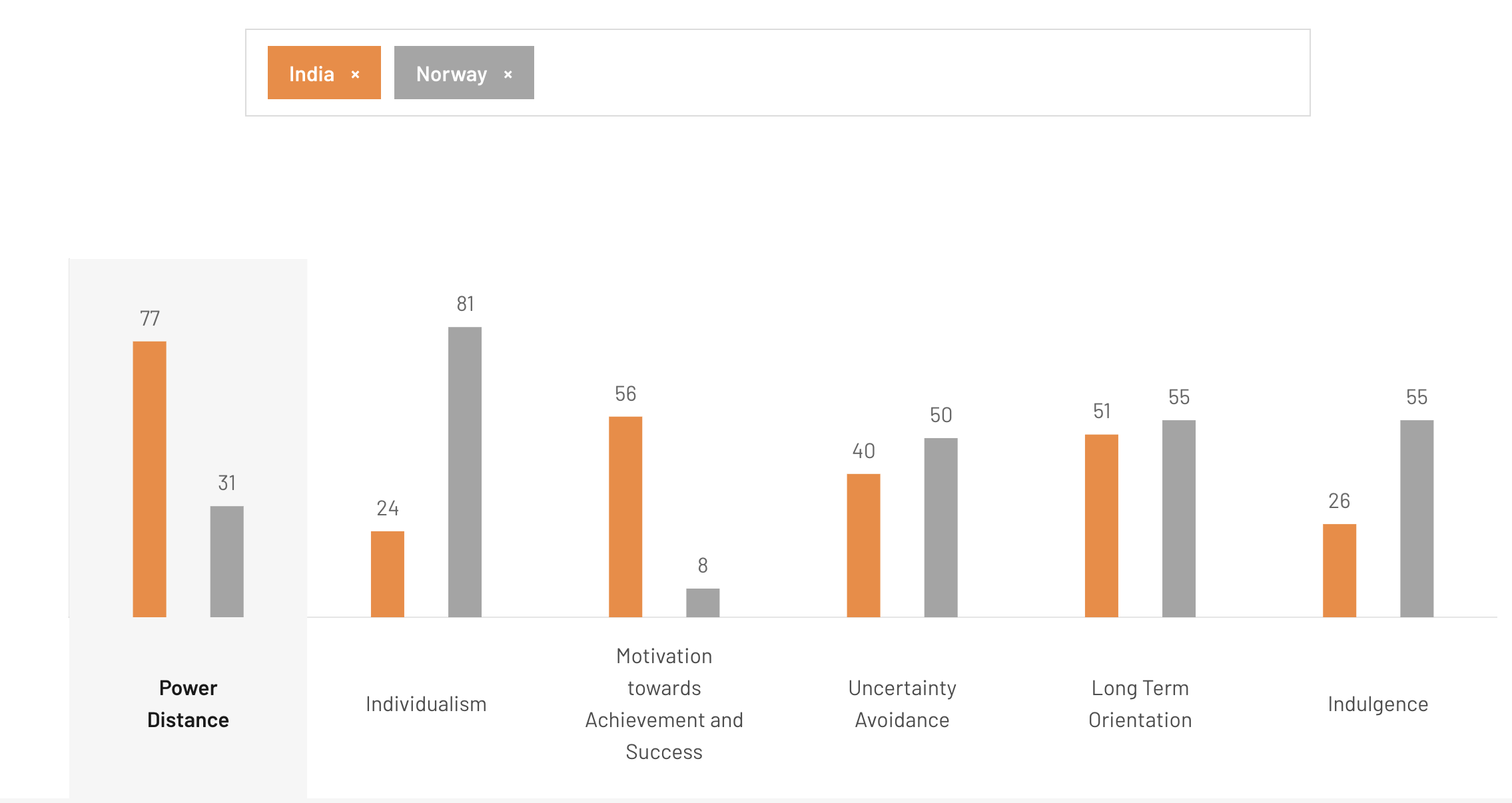
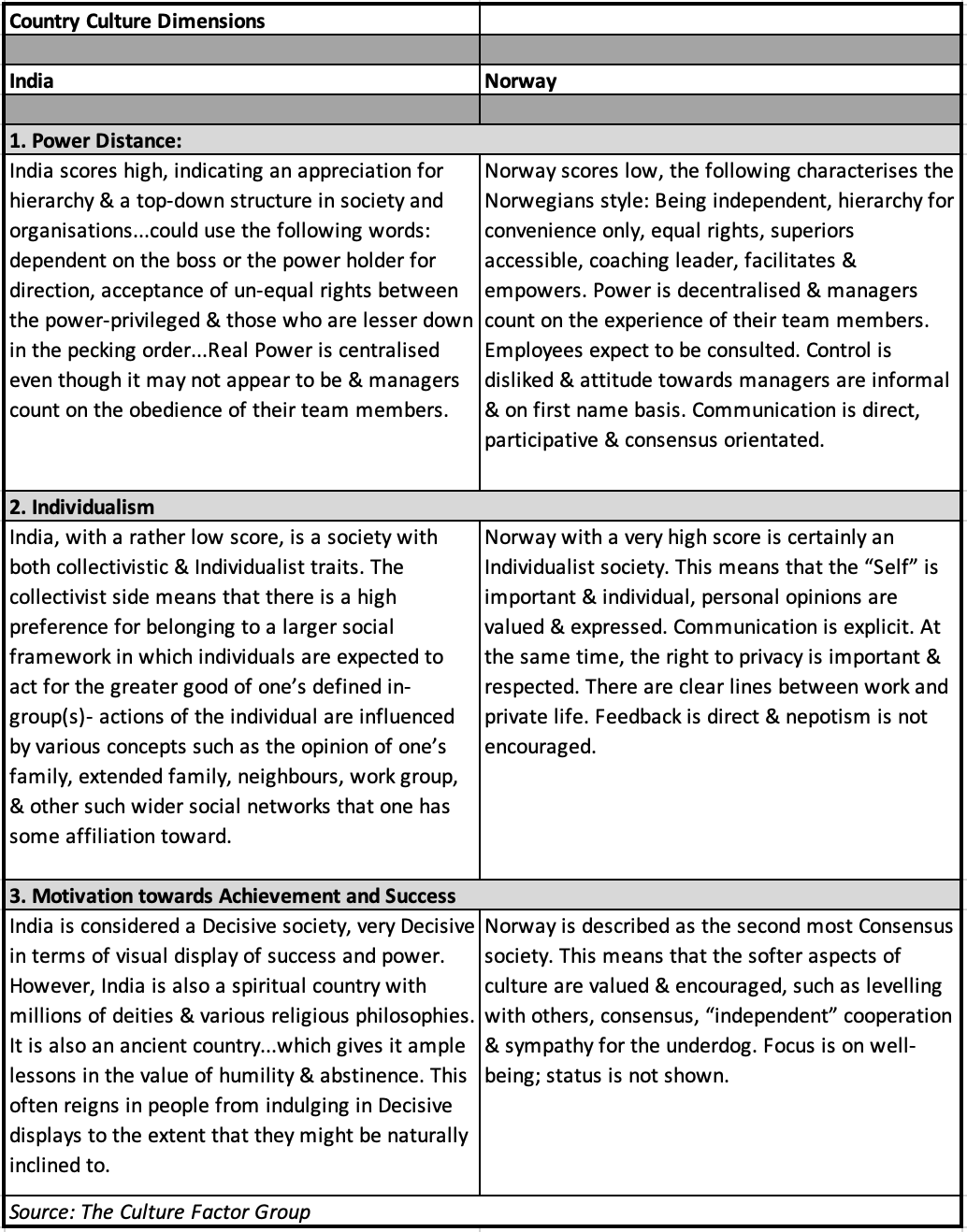
I gathered the following, selected notes from the The Culture Factor Group, Culture Dimensions Country Comparison tool – which compares India and Norway. Having lived and worked in Scandinavia for many years, I can see why it would be easy to misunderstand or ‘not get’ someone on the either side. The Culture Dimensions structure inputs originated from the late Prof. Geert Hofstede’s research. He was one of the most well-known experts in comparative intercultural research. These cross cultural inputs are updated through research notes periodically by the Culture Factor group.

According to inputs from the tool, major culture dimension differences exist between India and Norway in three out of the six dimensions – Power Distance, Individualism and Motivation towards Achievement and Success. Selected notes on these dimensions are included below. Hope this will help in thinking about the topic more deeper.

Notes On Workforce Analytics for Strategy Execution

This is a continuation of valuable notes from the free book, The Age of HR.

This post covers Chapter 14, Workforce Analytics for Strategy Execution: Ten Years Later (2015–2025) by workforce analytics guru, Mark Huselid. He co-authored the well known Harvard Business Review article, titled “A Players” or “A Positions?: The Strategic Logic of Workforce Management”.
There’s lots of valuable guidance and wisdom here, especially for those who have followed the topic of workforce analytics by Prof. Huselid over the years.

Image generated with Chatgpt

* 3 linked moves for leaders (HR & Line managers) who want to improve strategy execution through the workforce:
(1) identify the strategic work necessary to execute strategy;
(2) build differentiated workforce systems that enable that work;
(3) design measurement systems that connect workforce investments to business outcomes and reinforce accountability.
* ..the last decade has clarified a critical distinction: adopting analytics tools is comparatively easy; building an enterprise capability that reliably improves decisions is not.

* Not all jobs are equally strategic. “A” positions matter for strategy execution and exhibit high variability in individual performance, offering the greatest upside from improvement.
* Great firms manage their workforce like a portfolio, investing disproportionately in the highest return strategic work.

* This portfolio logic requires explicit tradeoffs.
* The practical test: Can senior leaders name the five to ten roles that matter most for executing the current strategy, and explain why those roles warrant disproportionate investment?

* Data abundance creates a false sense of progress.
* Enforce a simple rule-no measurement without a prior decision context.
If a metric does not help a specific decision-maker choose between competing alternatives, it should not be produced, regardless of how easy it is to generate.

* Correlation is abundant, causation is rare, and the difference determines whether workforce investments deliver returns or waste resources. Organizations that lack a causal model cannot learn from experience because they cannot distinguish signal from noise.

* In global settings, the strategic importance of jobs may differ by region.
“A positions” should not be treated as a single universal list; rather, the organization needs a consistent logic for identifying them, applied with contextual specificity.
* Identify strategic roles based on their contribution to strategy execution and performance variance, not tradition or hierarchy.

* Strategic jobs that matter today may not be the same five years from now.

* What works in one cultural context may not work in another.

* Advanced analytics raises concerns about privacy, fairness, and transparency. Embed responsible data management, informed consent, and bias checks into every step, treating ethics as integral to trust and long-term viability.

3 Enterprise Roles of the Transformational CHRO

Noticed these valuable notes on Transformational CHROs from the new book, The Age of HR, by Anthony Nyberg, Rebecca Kehoe, Dave Ulrich and Patrick Wright (editors).

These selected notes below are from Chapter 13, Beyond HR: The CHRO as a Catalyst for Enterprise Transformation, written by Melissa Anderson, Eva Rykrsmith, and Lynn A. McFarland.

The 3 Enterprise Roles of the Transformational CHRO

1. Integrator of Vision and Strategy
CHRO interprets signals from across the organization and the marketplace, translating noise into insight, and insight into action. This sensemaking function – converting ambiguity into coordinated action, requires strategic acuity, diagnostic rigor, and an ability to connect patterns that others miss. CHRO sees where energy is building, where resistance is forming, and where leaders may be misreading the moment. 
The Integrator grounds the operating system in reality, dismantling outdated accountability models and replacing them with adaptive structures, decision rights, and leadership practices that fit the company’s strategic ambition. By intentionally shaping culture as a designed condition, the CHRO ensures that employee experience reflects strategic intent, providing a shared environment where employees understand purpose, feel protected, and are empowered to perform.

2. Orchestrator of Execution
CHRO ensures that transformation is coherent across functions, geographies, and business units. They align leadership expectations, capability plans, operating models, and cultural interventions into a unified architecture. The Orchestrator meets leaders and teams where they are, using personal credibility and insight to influence adoption, guide alignment, and adapt interventions to context, ensuring that employees experience coherence, clarity, and support.
In practice, orchestration translates coherence into coordinated action. When culture is reinforced through predictable patterns of collaboration, accountability, and leadership behavior, employee experience becomes a visible outcome of alignment. The aligned, mutually reinforcing practices cultivate employee attitudes and discretionary behaviors essential for transformation.

3. Accelerator of Momentum 
The CHRO reduces friction and speeds up the organization’s path to outcomes. Acceleration involves more than urgency; it includes clearing structural bottlenecks, developing leadership capacity, prioritizing critical skills, strengthening collaboration, and embedding cultural mechanisms that reinforce desired behaviors.
In practice, the Accelerator ensures new capabilities and ways of working. CHRO shepherds this shift with equal measures of empathy and conviction, helping leaders internalize new expectations and align their teams. The HR team is activated to redesign operating models to reflect strategic intent, modernize workforce structures, develop readiness for future demands, and embed cultural mechanisms to reinforce momentum sustaining behaviors. Culture is reinforced as people experience tangible changes in work.

Powerful Notes /Reflection on Leadership

For unexplainable reasons, an article I had read around couple of decades back came to mind suddenly.

“Leader presumes follower. Follower presumes choice. One who is coerced to the purposes, objectives, or preferences of another is not a follower in any true sense of the word, but an object of manipulation. Nor is the relationship materially altered if both parties voluntarily accept the dominance of one by the other. A true leader cannot be bound to lead. A true follower cannot be bound to follow. The moment they are bound they are no longer leader or follower. If the behavior of either is compelled, whether by force, economic necessity, or contractual arrangement, the relationship is altered to one of superior/subordinate, manager/employee, master/servant, or owner/slave. All such relationships are materially different from leader/follower.

Induced behavior is the essence of leader/follower. Compelled behavior is the essence of all the other relational concepts. Where behavior is compelled, there you will find tyranny, however benign. Where behavior is induced, there you will find leadership, however powerful. Leadership does not necessarily imply constructive, ethical, open conduct. It is entirely possible to induce destructive, malign, devious behavior, and to do so by corrupt means. Therefore, a clear, constructive purpose and compelling ethical principles evoked from and shared by all participants should be the essence of every relationship in every institution.

A vital question is how to insure that those who lead are constructive, ethical, open, and honest. The answer is to follow those who behave in that manner. It comes down to both individual and collective sense of where and how people choose to be led. In a very real sense, followers lead by choosing where to be led. Where an organizational community will be led is inseparable from the shared values and beliefs of its members.

True leaders are those who epitomize the general sense of the community – who symbolize, legitimize and strengthen behavior in accordance with the sense of the community – who enable its shared purpose, values and beliefs to emerge and be transmitted. A true leader’s behavior is induced by the behavior of every individual choosing where to be led.”

Source: Hock, Dee “The Art of Chaordic Leadership” Leader to Leader. 15 (Winter 2000): 20-26.

Progress of Women In Corporate Roles

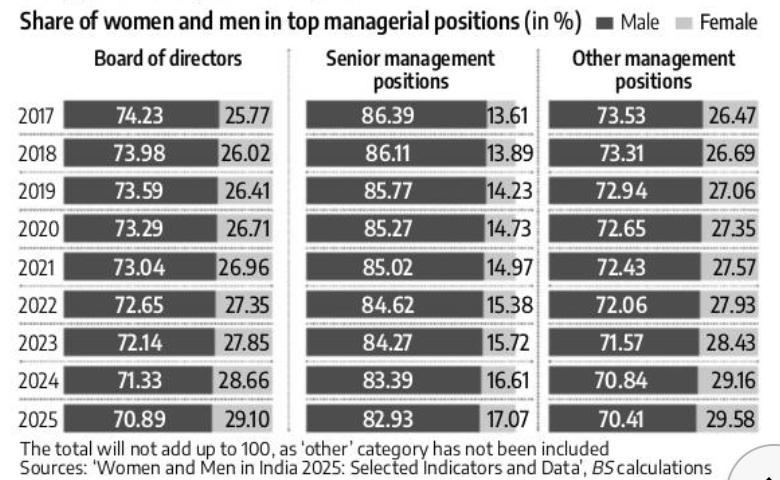
Data shared in this week’s Business Standard paper, based on the “Women and Men In India 2025 Report” indicates that there is a lot of continued work needed in this area. The data indicates basic incremental progress.

Some key notes:
* Even as women are making inroads into corporate leadership roles, gains remain limited. The change is gradual. Pay gaps continue to persist.
* Women representation in corporate boards inched up from 25.8% in 2017 to 29.1% in 2025 (similar incremental rises across other management roles). However, their share in senior management remains sharply skewed at just over 17%.
* Women’s labour force participation has risen from 23.4% in 2018 to 40% in 2025 but remains far below men at nearly 80%.


Source: Business Standard, May 7, 2026, Datanomics, Women See Limited Gains in Top Jobs, Shikha Chaturvedi.

© 2026 Lead-Wise

Theme by Anders NorenUp ↑