PURPOSE & IMPACT

Category: Organization (page 2 of 5)

The Power of ‘Curiosity’

These are valuable notes below for reflection on “Curiosity” from a recent Harvard Business Review article titled, The Right Way to Prepare for a High-Stakes Conversation. Curiosity mindset seems to drive learning. The powerful impact and related behaviours appear in many articles and studies, including leadership potential (Egon Zehnder).

“In a world where information is abundant but insight remains scarce, curiosity may be the ultimate competitive advantage.

If you wouldn’t fly on a plane that hadn’t had a preflight check, why head into a high-stakes conversation without first checking your most vital mindset: curiosity?

The question isn’t whether you’ll face disagreement and pushback in your next high-stakes conversation—it’s whether you’ll be mentally prepared to transform that into insight and constructive action.

Curiosity is a choice, and that choice begins before you speak your first word.

By honestly assessing where you sit on the Curiosity Curve, setting realistic intentions to move toward greater openness, and deploying targeted Curiosity Sparks, you can transform your most challenging interactions from battles to be won into opportunities for mutual discovery and collaborative problem-solving.”

According to the author, there are four surprising benefits of curiosity.
“1. When We’re Curious About People, They Like Us More.
2. Curiosity Begets Curiosity
3. Curiosity Creates Empathy
4. Curiosity Makes Us More Resilient

To get more curious, try asking yourself one of these “curiosity sparks.”
1. What might I be missing?
2. How else might someone else interpret this situation?
3. How might I be affecting them?
4. What can I learn from this person?


Can you build the curiosity mindset into your organisation culture?
Perhaps a good place to start with is in leadership and management development.

Sources:
* The Right Way to Prepare for a High-Stakes Conversation; Harvard Business Review; Jeff Wetzler; July 2, 2025
* 4 Surprising Benefits of Curiosity; PsychologyToday; Jeff Wetzler; December 12, 2024

Psychopaths in leadership roles? Trying to explore balance.

An interesting 2019 article by Tomas Chamorro-Premuzic (currently, Chief Innovation Officer of ManpowerGroup), discussed psychopaths and related traits in leadership roles.

These are selected notes from the article below.

* According a study dating back to 2010, there were at least three times as many psychopaths in executive or CEO roles than in the overall population.
But more recent data found it’s now a much higher figure: 20 percent.

* Spotting A Psychopath
Narcissism involves an unrealistic sense of grandiosity and superiority, manifested in the form of vanity, self-admiration and delusions of talent.
Main characteristics of narcissistic and toxic bosses:
1. They often crave validation and recognition from others.
2. They tend to be self-centered.
3. They have high levels of entitlement.

* As I highlight in my most recent book, “Why Do So Many Incompetent Men Become Leaders? (And How to Fix It),” many wildly celebrated character traits, such as courage and risk-taking, often coexist with psychopathic tendencies.

Finding The Balance
* To some degree, all successful entrepreneurs have problems with authority, which is why they are so eager to demolish the status quo and replace it with something else.
* So while a certain degree of nonconformity and unconventionality is needed to drive innovation and entrepreneurship, any leader will need to have a minimum level of integrity, empathy and altruism to be able to connect with and focus on the well-being of their teams, rather than on advancing their own personal agenda.
* It is this range of pro-social and ethical traits that can turn even contrarian and combative personalities into a catalyst for good in society: Replacing the status quo with a better version of progress.

Source:
1 in 5 business leaders may have psychopathic tendencies—here’s why, according to a psychology professor; cnbc.com; April 9, 2019; Tomas Chamorro-Premuzic

Tough Vs. Strong/Human-Centric Leadership

A recent MIT Sloan Management Review article, titled ‘Five Leadership Lessons for ‘Tough’ CEOs’, seems to be making a differentiation between tough and strong/human-centric leaders. It holds valuable reminders in the current environment, where backward steps seem to be taken frequently.

Selected notes from the article:

* Pre-pandemic, research had built compelling cases for human-centric leadership. This data was reinforced during the crisis as many businesses survived despite dire circumstances. Today, we’re seeing central corporate command try to reassert control to reinstitute old norms.
* Tough-talking leaders often fail to appreciate that reliability – the foundation of trust – is what builds results.
* Tough CEOs don’t recognize the value of human-centered leaders who tap into their emotional intelligence as much as their intellectual intelligence to deepen relationships in all the ways that improve workers’ performance.

Five Lessons for Tough Talkers From Strong Leaders
1. Tough leaders mistakenly think empathizing means giving in, but it doesn’t. Human-centered leaders empathize to better communicate and collaborate. Empathizing means connecting with what others are thinking and feeling. It’s the skill that cultivates safe spaces for creativity, builds strong team alliances, and gets to clarity on issues.
2. Human-centric leaders aren’t soft about employees’ performance. They don’t ask for less. Instead, they set clear goals and priorities. They monitor progress at the team and individual levels. And they align work with employees’ identified strengths and skills. Human-centered leaders check in regularly with team members to coach them and course-correct as circumstances evolve. They cultivate the fundamentals for exceptional performance, including a sense of belonging, by emphasizing outcomes.
3. Tough-talking leaders often fail to appreciate that reliability – the foundation of trust – is what builds results. A study conducted by i4cp found that organizations where people trusted their leaders were 11 times more likely to be high performers.
4. Strong leaders recognize that one size does not fit all. Each team’s purpose and realities are adjusted for and can be modified when business conditions and the needs of both the company and team members change.
5. Even in our fast-changing world, tough-talking leaders won’t admit to ever being wrong – despite unprecedented uncertainties. Evidence from Berkeley Haas professor Jennifer Chatman shows that such leaders cause long-lasting damage to organizations through reduced collaboration and integrity.

Challenging the tough-leader persona is essential for managing talent through volatility and ambiguity. Leaders need to nurture a sense of belonging to support strong performance.

Source: Five Leadership Lessons for ‘Tough’ CEOs; Brian Elliott and Sophie Wade; June 16, 2025; MIT Sloan Management Review

Notes on Organization Culture from from The Culture Factor Group (previously known as Hofstede Insights)

The Culture Factor Group takes a well structured approach (including assessments) on the topic of organization culture.

Here are some related perspectives and notes from them:

* Definition of “culture” – “the programming of the human mind by which one group of people distinguishes itself from another group”.  It is always a shared, collective phenomenon, that is learned from your environment.
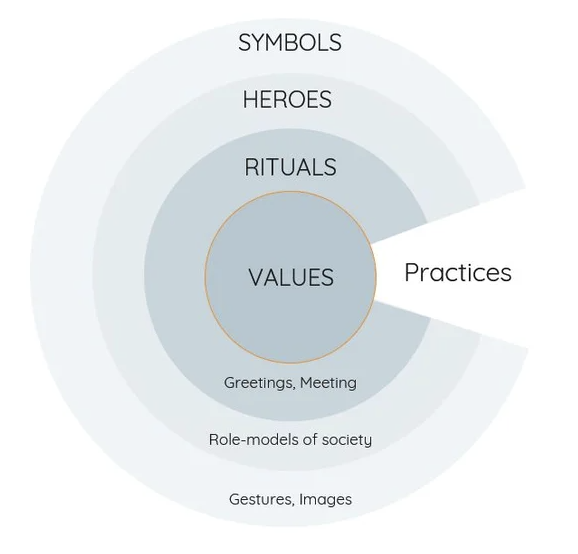
* Culture consists of various layers – symbols, heroes, rituals and values.

* Organisational Culture tends to be more straightforward and precise to measure than National Culture. This is because, unlike nations, most organisations have clear objectives and requirements.
* While differences between National Cultures are most apparent in the values, differences between organisations within the same nation can most clearly be seen in the practices of the organisations. This is also why Organisational Culture, unlike National Culture, can be changed by changing those practices.
* It is never a good idea to try to apply the culture of another organisation as the optimal culture for yours. Your context is unique, the founders of the organisation are different and the economical landscape is likely to be different.
* When it comes to shaping the culture of an organisation, leadership can play a particularly important role. The leaders are the ones who have the most influence over shaping it – Are they setting the right example? Do their actions align with the organisational values?

Dimensions of Organisation Culture
* Dimension 1: Organisational Effectiveness
* Dimension 2: Customer Orientation
* Dimension 3: Level of Control
* Dimension 4: Focus
* Dimension 5: Approachability
* Dimension 6: Management Philosophy

Source: Organisational Culture, What You Need To Know; The Culture Factor Group


Notes on Organization Culture from Heidrick & Struggles

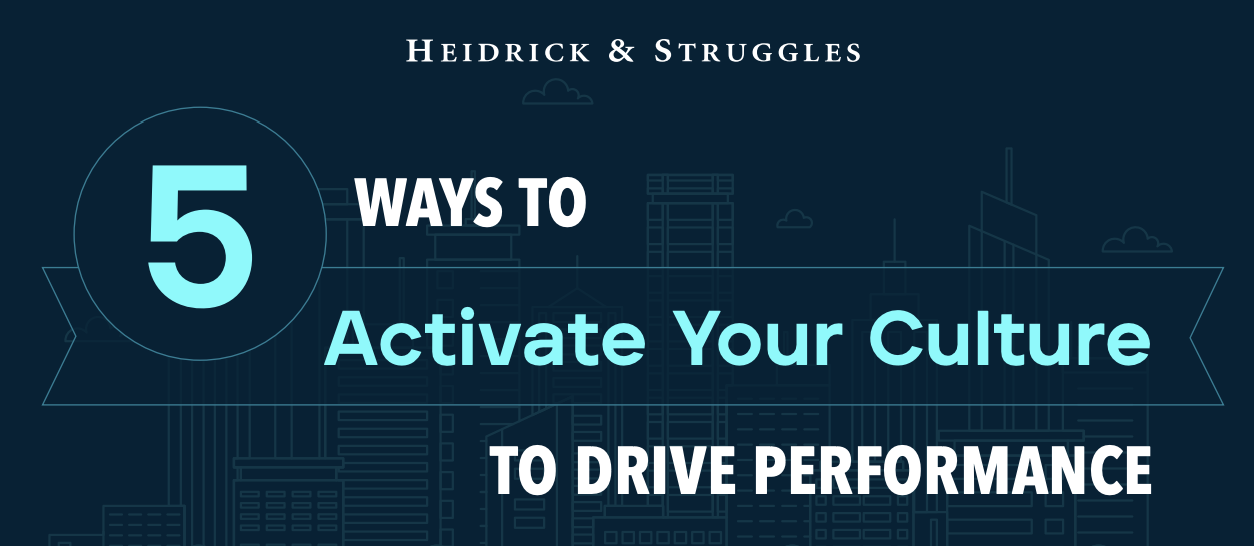
Executive search and leadership consulting firm, Heidrick & Struggles recently came out with an interesting infographic on organization culture.

Selected notes from the infographic:

* Companies with stronger cultures also have stronger financial results.
* Organizations with a high trust culture are 50% more productive, 76% more innovative.
* Strong cultures don’t happen on their own. They’re the result of active cultivation. 70% of change initiatives fail due to cultural resistance.

1. 49% of CEOs found focusing on culture “significantly improved” financial performance. 71% of CEOs view culture as a top-three influencer on financial performance. CEOs and Board of Directors must be visible active culture drivers.
2. Highly aligned companies grow revenue 58% faster. Align on purpose, strategy, structure and culture.
3. Only 13% of employees perceive their leaders to be effective communicators. Equip leaders to deliver a consistent message that explains the “what, why, and how” of the culture journey.
4. Employees will encounter your message 3-5 times before it resonates. (In my personal observation, it’s more). Activate a culture plan that engages people.
5. 92% of highly engaged workers feel listened to in the workplace. Measure progress and adjust (culture dashboard, metrics).

How could you make your organization and team culture stronger?


Source:
Infographic; 5 Ways To Activate Your Culture To Drive Performance; Heidrick & Struggles.

C-Level Leadership Trends from Korn Ferry and Related Reflections

The grass is not as green as it looks when it comes to corporate C-level leadership. Are C-suite jobs becoming more complex and short lived? If you are an aspiring C-suite leader, what does this mean for you?

These are selected notes from recent Korn Ferry Insight articles:

* According to recent updates from Korn Ferry, around 222 CEOs (US) left their roles in January, the highest number for the month in at least 23 years.  This comes after a record 2,221 top bosses – at US public, private, or government organizations – left their posts in 2024, a figure which itself topped the prior record of 1,914 set a year earlier.

* Disruption is a major cause of CEOs leaving, and then the CEO actually leaving is probably impacting that disruption further. Directors, themselves under pressure from a surge in activist investors, are showing less patience with CEOs who aren’t delivering positive results. At one point in 2024, nearly 40% of CEOs who left were forced out.

* When a CEO quits, it’s almost always a shock to the system. “All types of dynamics surface calling the success of the company’s future into question”.
As a result, experts say that firms need to make a special effort to develop promising talent. That may mean identifying potential successors who are currently working two or even three layers below the CEO job. 

* Firms also seem to be reducing C-suite roles by collapsing and combining positions. Some tech companies have merged the CFO/COO roles, for instance, while others have folded CCO duties into those of the CMO – a role that has added responsibilities for sales, customer experience, and more – or have rebranded them under titles like CRO. This may be because combining roles could enable firms to respond faster to changes involving markets and competitors. The role-merging has happened thus far only on a small but noticeable scale.

* Developing C-suite leaders with cross-functional experience also helps firms build a pipeline of ready successors. Still, experts caution that consolidation in the C-suite runs risks. The executive who’s taking on the additional responsibilities might not perform well in their new role. Burnout is a risk.


These are some of my reflections:
1. Companies have to increase focus on consciously developing and retaining leaders. Only focused efforts lead to positive outcomes at a systemic level.
2. A CEO change mostly leads to further leadership, talent and structural organizational changes. This can lead to major disruptions for talent, especially when uncertainty is high. Key talent engagement and retention should be on top of a leader’s agenda in such environments.
3. When a senior leader takes on multiple functions, time and attention tends to become a major challenge. Consciously or sub consciously, some teams and topics will get lesser leadership attention, leading to frustration for those members. This could lead to further disengagement. In such scenarios, it becomes critical for C-level leaders to ensure a strong second level of leaders, who can lead with high autonomy.
4. There seems to be increased chatter about broader job cuts in organizations in 2025 as well (which normally accompanies organization, work structure changes across all levels). eg. even when teams get consolidated, there are leadership and direction changes, which end up impacting even the junior levels.
5. Based on the trend of consolidation of leadership responsibilities, cross-functional/generalist experience could be back into serious leadership development focus.

Sources:
* The Shrinking C-Suite?; March 18, 2025; Korn Ferry Insights
* The Great CEO Exodus… Continues; March 12, 2025; Korn Ferry Insights

Ways To Manage With Omnipotent Leaders

A March 2025 article in the IMD site from a clinical/organisational psychologist, Merete Wedell-Wedellsborg, covers perspectives on this complex topic.

Selected notes from the article below:

“What to do when those in positions of authority behave in ways that contradict widely accepted norms of civility, empathy, and ethical leadership.

The only path forward is to engage and maximize your influence by building enough power and clout to respond effectively and understand the psychology of omnipotent leaders.

* Omnipotent leaders see themselves as exempt from the norms of ethical or socially acceptable behavior due to a heightened sense of self-importance and entitlement. The mission (or rather their mission) justifies most, if not all, means to an end. Such leaders often exhibit moral licensing, believing past good deeds justify present transgressions. A tell-tale sign is excessive risk-taking and skirting formalities and rules of procedure.
* Omnipotence can also be understood within the broader framework of leadership overconfidence and hubris. The hubris syndrome is a condition wherein prolonged power and success lead to narcissistic tendencies, overconfidence, and diminished capacity for critical self-reflection.

Three key approaches can be employed while engaging with omnipotent leaders:
* Rather than challenging an omnipotent leader head-on, anchor your ideas as a natural plot in the leader’s vision, define yourself as a main character, and shape the narrative early. Whoever speaks early sets the stage.
* Frame feedback to omnipotent leaders that align or complement their self-image. Validate their leadership before steering the conversation toward constructive insights.
* Speed matters – shape the story before they do. Build rapport by finding even the smallest points of agreement. If escalation is inevitable, don’t go for it alone.

In a world where power dynamics are accelerating and all-powerful leaders set the tempo, the challenge is not simply to resist or comply but to navigate strategically and psychologically. “


What other approaches have worked for you?

Source: Three ways to deal with the almighty boss; Merete Wedell-Wedellsborg; 14 March 2025; I by IMD
Image Source: TungArt7, Pixabay

A glowing example of relationship across cultures, and beautiful words of tribute for Osamu Suzuki

Maruti Suzuki India Limited (MSIL) Chairman R C Bhargava on Osamu Suzuki, who led Japan’s Suzuki Motor for more than four decades and played a key role in turning India into a flourishing auto market. Osamu Suzuki died on Christmas day, aged 94.

“I have lost someone who was closer than a brother. He changed my life and showed how nationality is no barrier to people building unbreakable bonds of trust in each other. He was my teacher, mentor and person who stood by me even in my darkest days. If I played a role in the success of Maruti, it was because I was his student and he taught me how best to grow a firm and make it competitive…”

In April 1982, when Osamu Suzuki, then President of Suzuki Motor Corporation, signed a Memorandum of Understanding with Maruti Udyog Limited to manufature a 800cc car(which later became the iconic Maruti 800), a carry van and a pickup truck, even the Japanese embassy in Delhi was not in favour of the deal. Bhargava, then an IAS officer working at Maruti, had met Suzuki for the first time just a month before the MoU was signed.

In the first year of production, about 850 units of Maruti 800 were sold. Last financial year, MSIL produced 2.135 million vehicles. Today, MSIL is India’s largest car maker with more than 40 percent market share by volume.


——-

Source: Business Standard, 28 December 2024, Visionary auto tycoon who made winning bet on India, Reuters, Tokyo, 27 December, 2024

Why “Psychological Safety” Cannot Be Ignored By Any Organization

Psychological Safety is a critical element of highly effective teams and impactful work. This is too important to ignore for leaders, teams and organizations.

Google researchers did a famous study to discover the secrets of effective teams. It was code-named Project Aristotle – a tribute to Aristotle’s quote, “the whole is greater than the sum of its parts”. The goal was to answer the question: “What makes a team effective at Google?”

The researchers found that what really mattered was less about who is on the team, and more about how the team worked together.

They found that psychological safety is the most important element of team effectiveness. “Psychological safety refers to an individual’s perception of the consequences of taking an interpersonal risk or a belief that a team is safe for risk taking in the face of being seen as ignorant, incompetent, negative, or disruptive. In a team with high psychological safety, teammates feel safe to take risks around their team members. They feel confident that no one on the team will embarrass or punish anyone else for admitting a mistake, asking a question, or offering a new idea.”

According to Dr. Amy C. Edmondson, Harvard professor who researched/developed this concept shares that over a thousand research papers in fields ranging from education to business to medicine have shown that teams and organizations with higher psychological safety have better performance, lower burnout, and, in medicine, even lower patient mortality. 

Sources:
* Understand team effectiveness; Google
* The Intelligent Failure that Led to the Discovery of Psychological Safety; Behavioral Scientist; October 4, 2023

Leadership Framework – ‘Leadership House’

I’ve been following leadership frameworks over the years. Leadership frameworks are quite interesting to study because they tend to highlight the critical elements and expert thinking about effective leaders and leadership.

This new framework shared in IMD (Switzerland) seems to reinforce the fundamental elements and bring together nicely (with case examples).
According to the article, Patrick Flesner who developed this ‘Leadership House’ framework, has experiences in top-level sports, roles as a partner in prestigious German law firms, leadership position in a publicly traded company, partner in a venture capital fund and author. Probably, bit of the European context as well.

Selected Notes:
* The Leadership House is built on a solid foundation of trust. Trust provides a strong feeling of safety. In trusting relationships, it’s about the issue, not the person.
* A strong team is the first pillar. It’s about more than hiring the right people and putting them in the right roles.
* Having the right people has two dimensions: the first is functional fit and the second is cultural fit. A strong culture is a competitive advantage and separates the best teams from the rest.
* Purpose and vision are important but almost always intangible. It is vital to clarify what must be done to achieve your company’s vision and turn it into reality. We should invite team members to the goal-setting process and ask them about what they believe must be done to turn purpose and vision into reality. In this way, our team members will become the owners of the goals and do whatever possible to achieve them, which is psychologically very powerful.
* We must ask our teams to translate shared goals into “joint plans”. We must show what each team and its members must do (and, importantly, deliver in terms of results) so we achieve our shared goals. Joint plans are more granular and make execution possible.
* Team members are held accountable for both the tasks and the results they achieve. This is why it is so important that joint plans also show the results to be delivered.
* We can only hold team members accountable if we empower them.
* Without execution, there are no results; without results, there is no effective leadership. Execution is where leadership shifts from theory to practice, yet it’s often where leaders struggle the most. One of the key challenges is finding the right level of involvement – too much oversight risks micromanagement, stifling creativity and independence. Too little involvement leads to confusion and a lack of direction.
* No leader has all the answers, and that’s fine. Leadership isn’t about knowing everything but about creating the conditions for your team to find the answers together. In life and business, outcomes depend on external factors, and, often, a bit of luck. What we can influence and control is building a great team, setting it up for success, and working together toward shared goals.

Source:
I by IMD; The Leadership House: Building solid foundations for leadership and business success; Patrick Flesner; 18 November 2024

Older posts Newer posts

© 2026 Lead-Wise

Theme by Anders NorenUp ↑